Florencio Molina Campos Exhibition Opens in Buenos Aires, Marking 100 Years Since His First Solo Show


Florencio Molina Campos Exhibition Opens in Buenos Aires, Marking 100 Years Since His First Solo Show
Paintings, popular calendar illustrations and an immersive audiovisual installation come together at Palacio Libertad in a centenary exhibition devoted to the Argentine artist.
An exhibition marking the centenary of Florencio Molina Campos’s first solo show opened at Palacio Libertad in Buenos Aires on October 23, 2026.
Titled Florencio Molina Campos. Costumbres argentinas, the exhibition presents paintings of rural Argentine life alongside an audiovisual installation that brings the artist’s characters and settings into motion. The exhibition is open to visitors until December 13.
The project was developed with the collaboration of the Museo Florencio Molina Campos. The artist’s grandson, Gonzalo Giménez Molina, is responsible for the exhibition’s concept and curatorial direction.
Caricature and country life
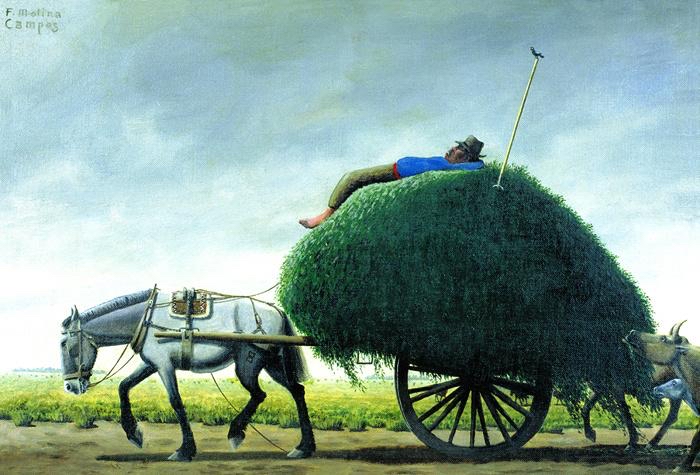
Florencio Molina Campos was born in Buenos Aires on August 21, 1891. His paintings drew on the people, animals and customs he encountered in the Argentine countryside, where he spent time from an early age.
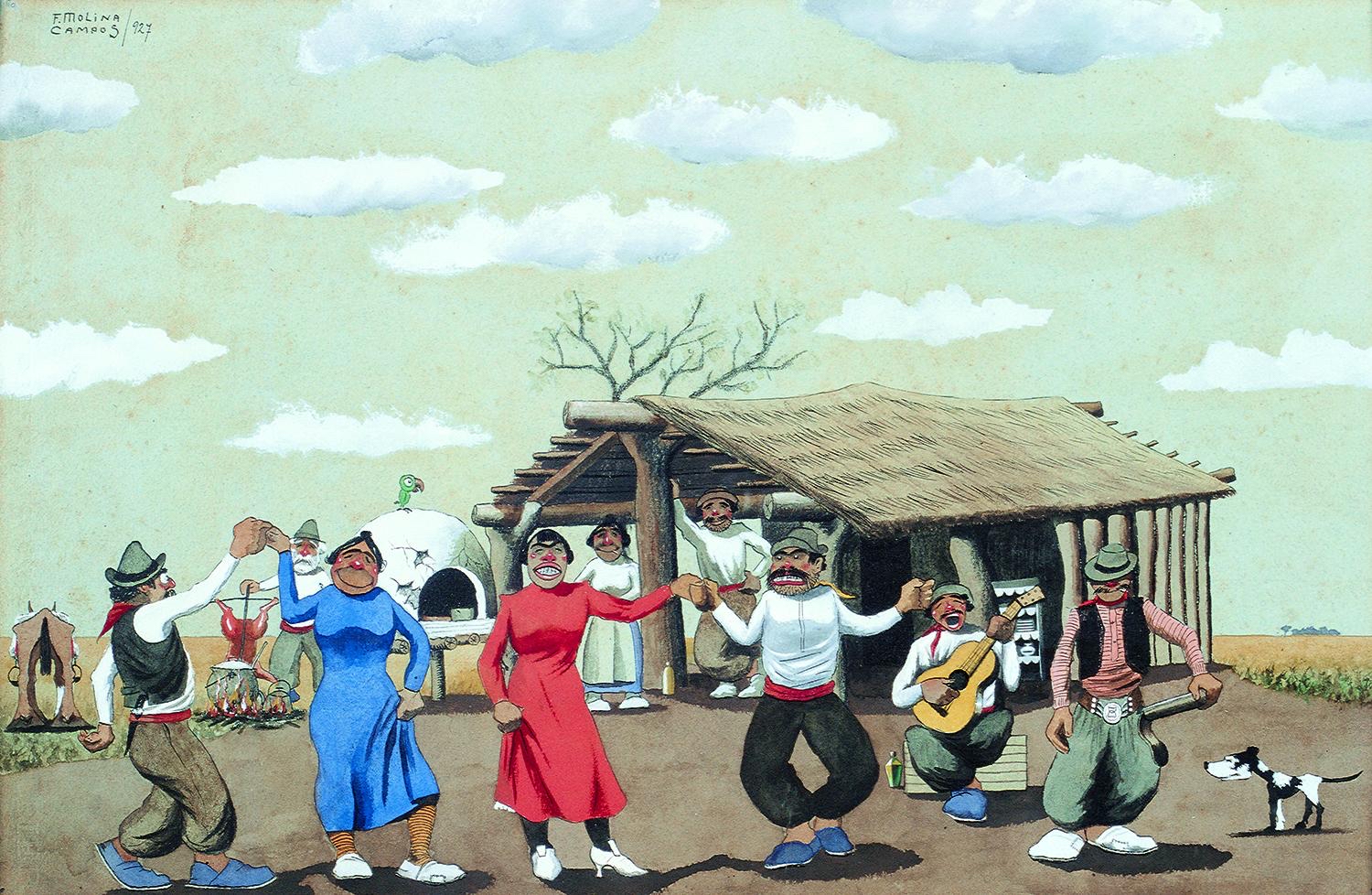
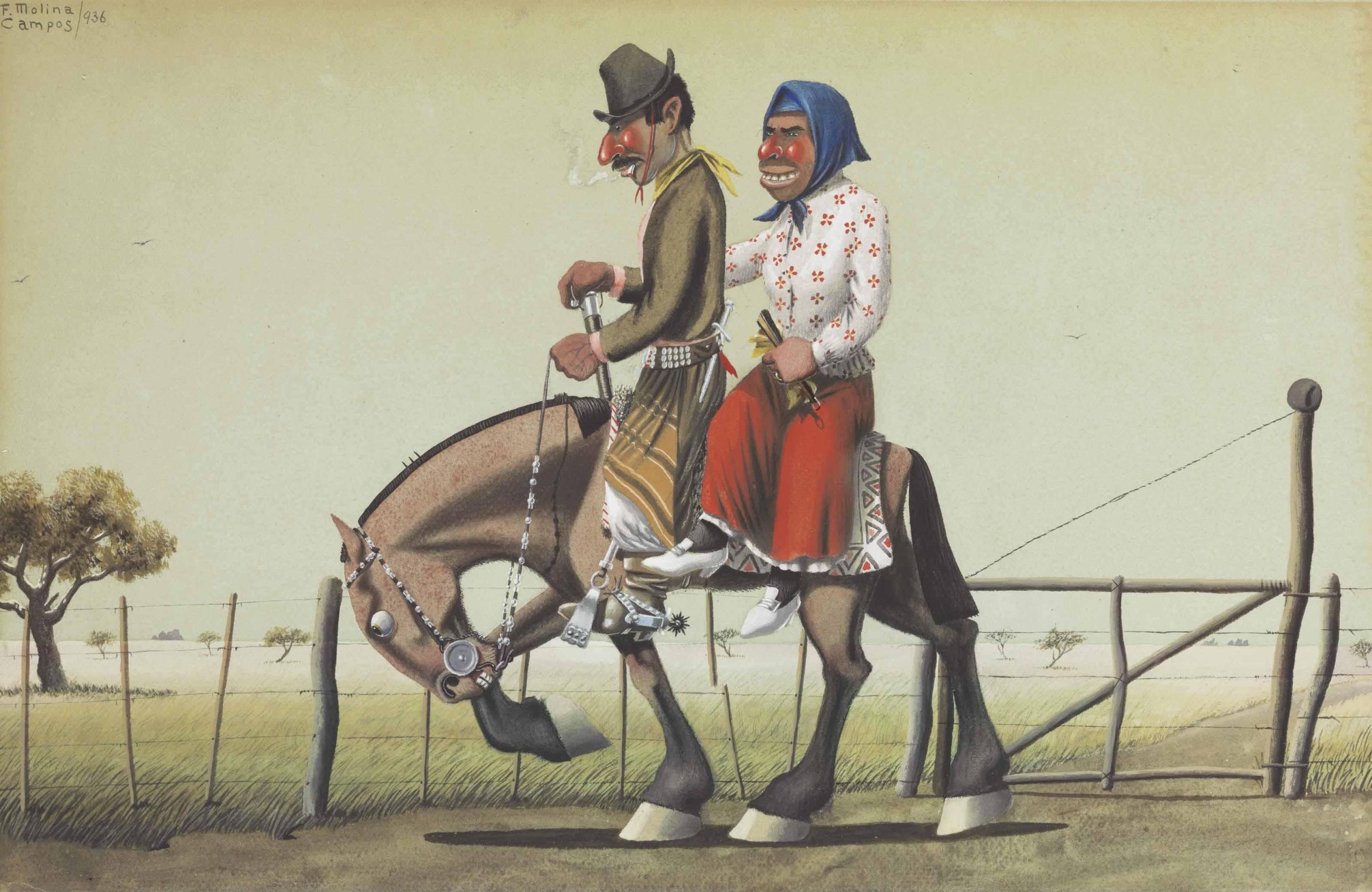
His gauchos are rarely solemn figures. They dance, ride horses, play music and gather around the fire. Their expressions are exaggerated, sometimes to the point of caricature, but the scenes remain grounded in recognizable details of rural life.
Molina Campos’s first major solo exhibition, Motivos gauchos (caricaturas), was held at the Sociedad Rural Argentina in Buenos Aires on August 21, 1926, his thirty-fifth birthday. The presentation included 61 pastels and watercolours.
The calendars that carried his work across Argentina
Molina Campos became widely known through the illustrated calendars produced for the Argentine company Alpargatas. In 1930, the company commissioned twelve paintings for its 1931 calendar.
Further commissions followed through the 1930s and early 1940s. Reproductions of his paintings appeared in shops, railway stations, homes and other everyday settings, reaching people who might never have visited an art exhibition.
The calendars also gave Molina Campos room to develop recurring characters and scenes. Among them was Tiléforo Areco, a gaucho whose adventures appeared in a series of illustrations.
This aspect of his career is part of the exhibition at Palacio Libertad, which considers not only the original paintings but also the way his work circulated through printed images.
Two rooms, two ways of seeing the work
The exhibition occupies two spaces on the second floor of Palacio Libertad.
In Sala 206, visitors encounter paintings depicting different aspects of rural social life, including dances, music, horseback activities and quieter moments such as sharing mate or resting outdoors.
The Sala Inmersiva offers a different presentation. Using images, sound and three-dimensional animation, the installation follows the course of a day in the countryside through scenes inspired by Molina Campos’s paintings.
The audiovisual work was produced by Palacio Libertad’s post-production team. Tato Araoz was responsible for creative direction and 3D animation.
A connection to animation
Molina Campos had a professional connection with animation long before digital technology. He worked as an adviser to Walt Disney’s studio in the early 1940s, although disagreements arose over how gauchos and South American customs were represented. The new installation returns to the idea of translating his drawings into moving images.
Returning to a familiar building
The venue has a personal connection to Molina Campos. According to Palacio Libertad, he worked in the building during his youth, when it served a different purpose.
A century after the 1926 exhibition that helped launch his career, his paintings are now being shown there alongside a digital installation. The centenary provides an occasion to revisit both his original work and the illustrated calendars that made it familiar across Argentina.
Molina Campos died in Buenos Aires on November 16, 1959. His work continues to be preserved and exhibited by institutions dedicated to Argentine art and cultural history.
Exhibition information
Sarmiento 151
Buenos Aires, Argentina
6:00 PM
2:00–8:00 PM
2:00–8:00 PM
No advance reservation required
Sala 206 and Sala Inmersiva