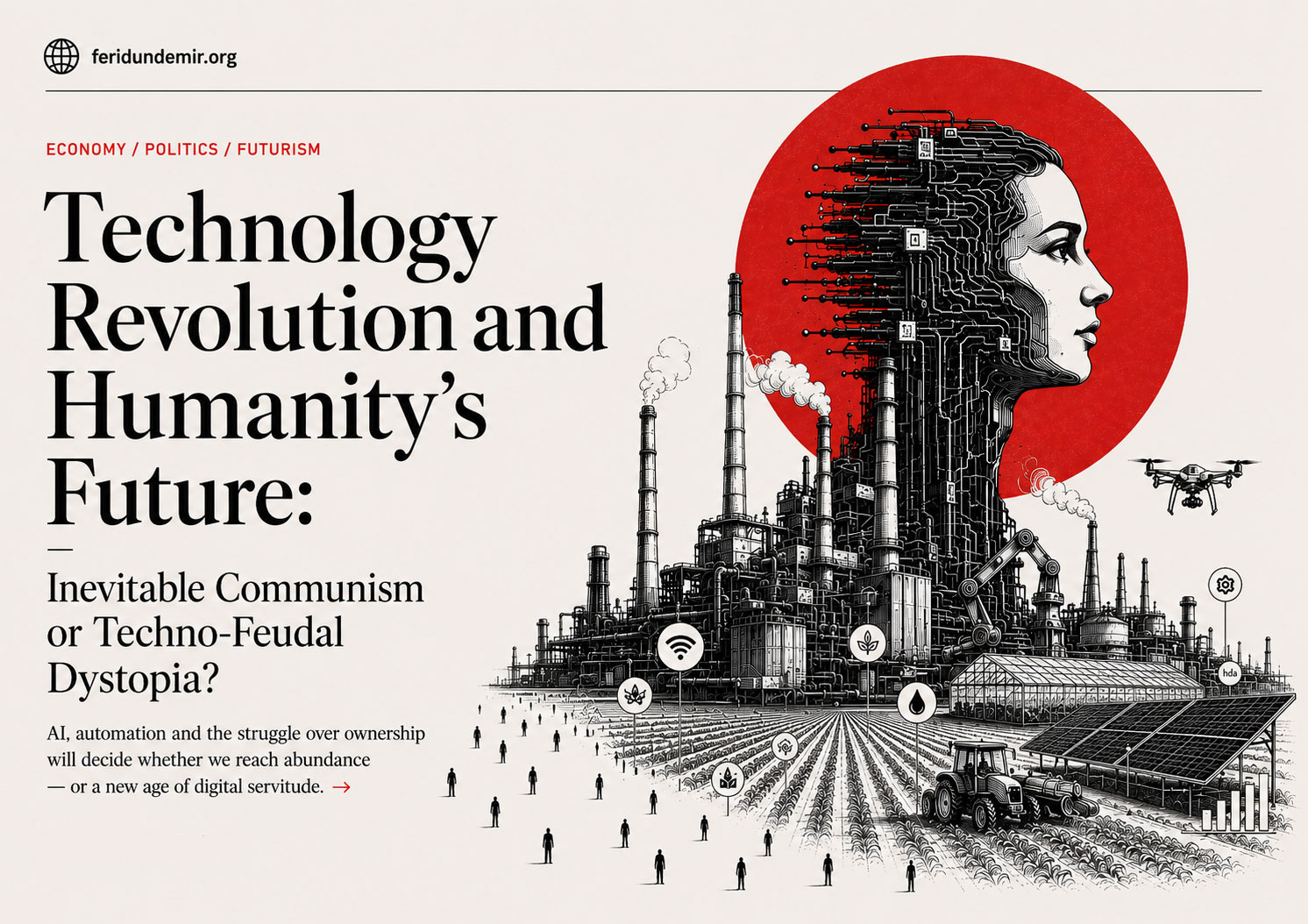
Technology Revolution and Humanity’s Future: Inevitable Communism or Techno-Feudal Dystopia?


By Feridun Demir
The Industrial Revolution transformed human muscle power. The computer revolution reshaped intellectual labor. The ongoing artificial intelligence revolution, however, is the first technological transformation with the potential to replace both physical and cognitive labor simultaneously.
Across the globe, tasks once performed by millions of workers—from customer service and logistics planning to software development, design, and research—are increasingly being handled by algorithms. Industrial robots continue to reduce human involvement in manufacturing, while generative AI systems are beginning to automate significant portions of white-collar work.
This development is more than a technological shift. It represents a historic rupture capable of transforming the very foundations of political economy.
The central question is no longer whether artificial intelligence will change society.
The real question is:
How can capitalism function in a world where human labor is no longer economically indispensable?
And perhaps even more importantly:
What comes after capitalism?
Artificial Intelligence and Capitalism’s Fundamental Contradiction
At its core, capitalism operates through a relatively simple mechanism:
- Workers sell their labor.
- Goods and services are produced.
- Those goods and services are sold in the market.
- Capital accumulates.
The rise of automation and artificial intelligence threatens to disrupt this cycle.
As machines become capable of performing an increasing share of productive activity, fewer workers are required. For corporations, reducing labor costs is often viewed as a measure of success. AI accelerates this tendency dramatically.
Yet here lies capitalism’s deepest contradiction.
If a growing portion of the population loses access to wages, who will purchase the goods and services being produced?
Henry Ford famously understood this dilemma. His workers needed sufficient income to buy the automobiles they manufactured.
In a fully automated economy, production capacity may continue expanding while purchasing power stagnates or declines.
The result could be a new form of the crisis Karl Marx identified nearly two centuries ago: a crisis of overproduction in which society possesses the capacity to produce abundance but lacks the mechanisms to distribute purchasing power.
The Promise of a Post-Scarcity Society
Many technological optimists envision a radically different future.
They argue that artificial intelligence, advanced robotics, fusion energy, biotechnology, and automated manufacturing could create the first truly post-scarcity society in human history.
In such a world:
- The cost of producing essential goods approaches zero.
- Energy becomes abundant and inexpensive.
- Robots perform most necessary labor.
- Human beings are no longer forced to work merely to survive.
One of the most well-known contemporary expressions of this vision is often described as Fully Automated Luxury Communism.
According to this perspective, technological progress naturally paves the way for a more egalitarian society.
However, this optimistic scenario depends on a critical and often overlooked question:
Who owns the means of production?
Technology alone does not alter social relations.
A factory operated entirely by robots does not automatically become collectively owned.
Ownership remains the decisive factor.
Historical Materialism Beyond Determinism
One of the most persistent misunderstandings of Marxism is the assumption that Marx believed capitalism would inevitably and automatically evolve into socialism.
This interpretation oversimplifies historical materialism.
Marx argued that contradictions between productive forces and existing social relations generate pressures for transformation. Yet he never suggested that history follows a guaranteed path toward emancipation.
Historical development creates possibilities, not certainties.
Technological progress may create the material conditions necessary for a more equal society, but it can just as easily strengthen systems of domination.
This is why Rosa Luxemburg’s famous warning remains relevant today:
“Socialism or barbarism.”
Her statement captures a fundamental truth often forgotten in discussions about technological progress.
History offers opportunities.
It does not offer guarantees.
The Rise of Techno-Feudalism
While some observers anticipate post-scarcity abundance, others warn of a very different outcome.
In recent years, a growing number of scholars and political economists have used the term Techno-Feudalism to describe a possible successor to traditional capitalism.
According to this view, economic power may become concentrated not primarily in factories or industrial assets, but in ownership of:
- Artificial intelligence systems
- Data infrastructures
- Cloud computing networks
- Energy grids
- Semiconductor production
- Digital platforms
The world’s most powerful corporations increasingly derive their influence from control over information, algorithms, and digital infrastructure rather than traditional manufacturing alone.
Developing advanced AI systems requires enormous computational resources, massive datasets, specialized chips, and vast energy consumption.
As a result, technological advancement may paradoxically increase centralization rather than decentralization.
The danger is not a shortage of production.
The danger is the concentration of ownership.
In such a scenario, society could witness the emergence of a new ruling elite possessing unprecedented control over productive capacity while large segments of the population become economically redundant.
Citizens might receive basic income payments sufficient for survival, yet remain excluded from meaningful participation in production, decision-making, and ownership.
This would not be the classless society envisioned by technological utopians.
It would resemble a digitally managed form of neo-feudalism.
Class Struggle in the Age of Artificial Intelligence
Industrial capitalism organized class conflict around factories and industrial labor.
Artificial intelligence shifts the battlefield.
Future struggles may increasingly revolve around:
- Data ownership
- Algorithmic governance
- Computational infrastructure
- Energy systems
- Digital property rights
The central political question of the twenty-first century may no longer concern who owns the factory.
Instead, it may concern who owns the algorithm.
Artificial intelligence itself is neither liberating nor oppressive.
Its social consequences depend entirely on the structures of ownership and power within which it operates.
Marx’s Essential Insight: History Must Be Made
Perhaps the most important lesson from Marx is found in his famous eleventh thesis on Feuerbach:
“The philosophers have only interpreted the world, in various ways; the point, however, is to change it.”
This statement highlights a crucial distinction.
Technology creates possibilities.
Human beings determine outcomes.
Artificial intelligence may contribute to an unprecedented expansion of freedom and prosperity.
It may also provide the tools for the most sophisticated systems of surveillance and control ever constructed.
Neither future is inevitable.
Both remain historically possible.
Conclusion: The Future Will Be Decided by Ownership, Not Technology
Artificial intelligence and automation may generate the greatest increase in productive capacity since the beginning of civilization.
The decisive issue is not technological capability.
The decisive issue is ownership.
If artificial intelligence remains concentrated in the hands of a small global elite, humanity may enter an era characterized by extreme inequality, digital dependency, and techno-feudal domination.
If, however, the benefits of automation are organized around collective social interests, a future of reduced compulsory labor, material abundance, and expanded human freedom becomes conceivable.
The defining political question of the twenty-first century is therefore not whether artificial intelligence will continue to advance.
That much appears inevitable.
The real question is:
Who will own the machines, the algorithms, and the immense productive power they create?
The answer to that question may determine the future of human civilization itself.