From Fencing the Land to Fencing the Data: Is a New Luddism Possible?

The First Seed of Property and the Bondage of the Land
Human history is fundamentally the story of how our relationship with nature was transformed into an instrument of domination. In the feudal era, land was not merely a place to live; it was a prison where human life was bound by blood and toil. The peasant—the serf—was essentially a part of the property, a living inventory item. The authority of the feudal lord did not come from fences alone, but from the direct power to control the life pulsating on that land. This “physical” form of ownership eventually gave way to a more abstract but sharper separation: the commodification of the earth itself.
The first fences drawn around the commons were more than just boundary markers; they were the seeds of a mindset that turned the source of life into a commercial asset. When land ceased to be the ground everyone walked upon and became a “title deed” in someone’s pocket, human alienation was buried into the soil along with those first stakes.
The Great Displacement: From Craftsmanship to Labor
The most violent rupture began when those first physical fences drove people not just off the land, but away from their own essence. As feudal ownership turned into capital, peasants driven from their fields were forced into the smog of rising cities. They no longer had land to plant, nor a plow to till it. The individual who once determined their own fate by the rhythms of the earth became “labor power,” sold by the hour.
In this process, craftsmanship took a fatal blow. The dexterity of the human hand was sacrificed to the standardized gears of great factories. The separation from the land was not just a change of scenery; it was the severing of the vital umbilical cord between the human being and the means of production. Once a partner to nature, the human was now a mere cog—a replaceable part in a vast mechanical room.
From the Sound of Sledgehammers to Lines of Code
By the time this process reached the 19th-century English heartlands, where angry crowds smashed weaving looms with sledgehammers, the fight was about more than just property; it was about lost dignity. These Luddites were not protesting technology itself, but the fact that their centuries-old craft was being devalued by the machine.
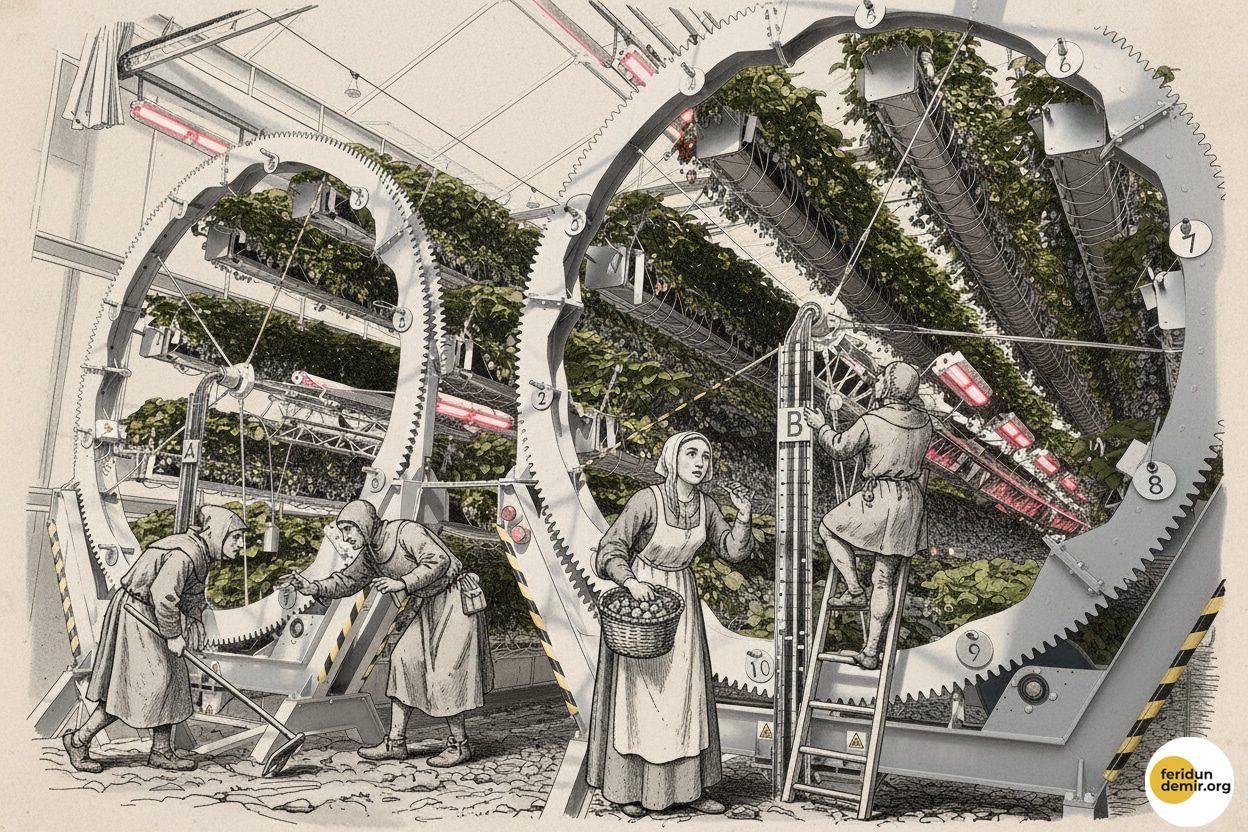
Today, the sound of the sledgehammer has fallen silent, replaced by a quieter, more insidious power: software code. It is no coincidence that a tech giant—the one famous for the vacuum cleaners in our living rooms—is now claiming dominion over vast agricultural empires. We are now witnessing the era of “Digital Fields.” Sensors and drones are not just bringing efficiency; like the first feudal fences, they are enclosing the very knowledge of the earth into a private server. The farmer, once the master of the soil, then a factory worker, is now becoming a “temporary data operator” for a corporation. Not only is the land and labor being fenced in, but the thousand-year-old wisdom of how to grow food is being privatized.
Walls That Do Not Fall on Their Own
Will this digital enclosure crumble by itself? History teaches us that no wall of property cracks of its own accord. The concentration of the means of production—whether a plow or a sophisticated AI algorithm—in the hands of a few creates a bottleneck in human progress. However, this stagnation does not automatically open the door to a new world.
The struggle today is not about rejecting technology, but about questioning—and reclaiming—for whose benefit it operates. Those resisting in the fields or behind screens today share a common grievance: the absolute dominance of those who own the tools of life over the rest of society. Turning this tide requires more than a simple “objection”; it requires a fight to re-socialize the ownership of knowledge and tools.
Imagining a New Commons
If an algorithm can calculate the mineral needs of the soil in seconds, that knowledge should not be a corporate trade secret; it should be the common heritage of humanity. The solution is not to smash the machines, but to build a collective will that changes their purpose.
Technology can shift from being a tool of alienation to a key of liberation—freeing us from drudgery—only when its ownership is transferred from the boardrooms to the public. In a world where production is planned for human need rather than profit, agriculture ceases to be a site of exploitation and becomes a conscious art form in harmony with nature.
The hand that builds the fence will one day realize its futility—but only when those outside the fence stand together, not as employees of an empire, but as partners in life.
Share this content:
Discover more from Feridun Demir
Subscribe to get the latest posts sent to your email.