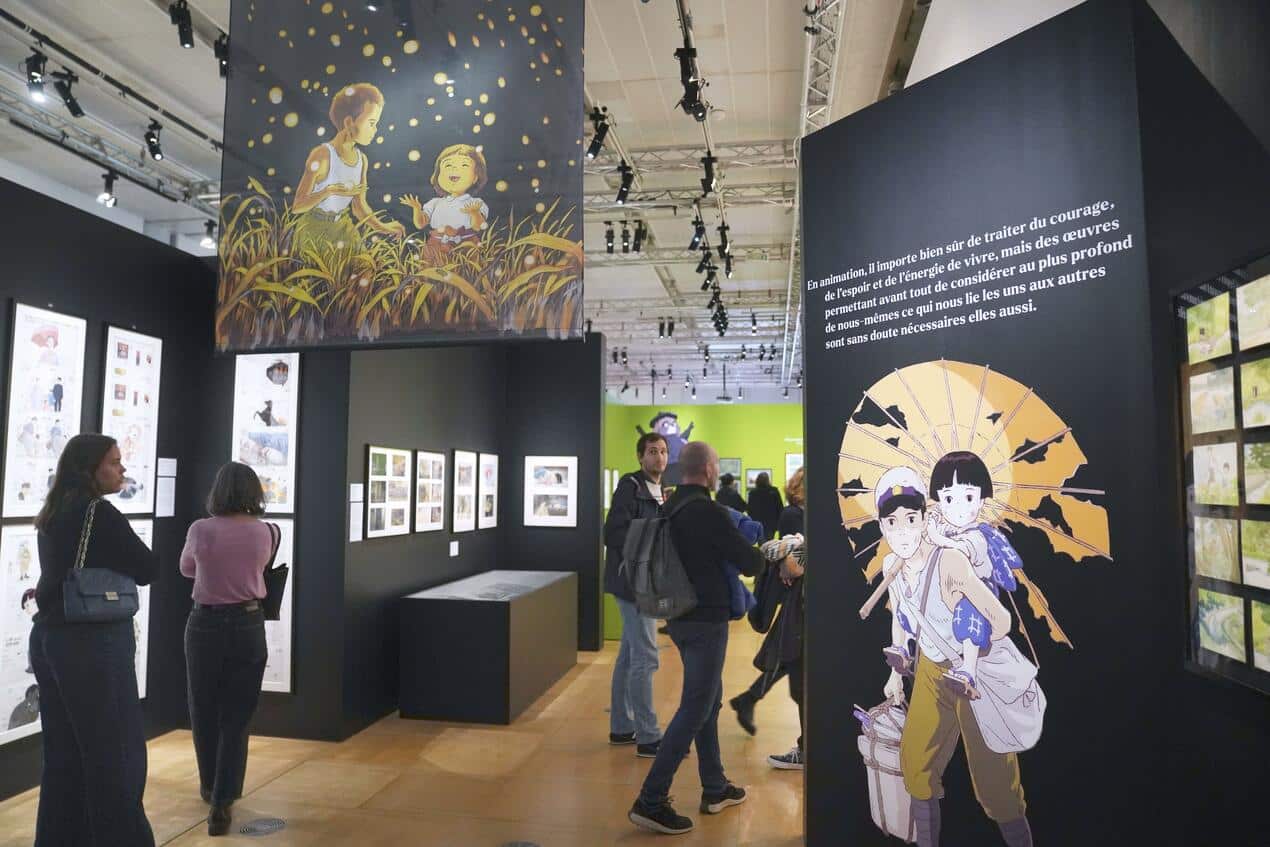
When we talk about animation history, the spotlight often falls on spectacle, fluid movement, and fantasy worlds. Yet few filmmakers reshaped animation as profoundly—and as quietly—as Isao Takahata. A co-founder of Studio Ghibli and one of Japan’s greatest directors, Takahata is now the subject of a major retrospective exhibition in Paris.
Titled “Isao Takahata – Pioneer of Contemporary Animation: From Post-War Japan to Studio Ghibli,” the exhibition is hosted at the Maison de la Culture du Japon à Paris and has been extended until February 7, 2026, following strong public interest. For fans of animation, illustration, and visual storytelling, this is far more than a nostalgic look back—it’s a deep dive into how animation became a mature, humanist art form.
An Alternative to the Disney Model
Born in 1935, Isao Takahata took a radically different path from the dominant animation styles of his time. While much of global animation chased visual polish and exaggerated motion, Takahata focused on story, rhythm, everyday life, and emotional truth.
The exhibition makes this contrast immediately clear. Beginning with his early work at Toei Doga (now Toei Animation), visitors follow his career chronologically. His first feature film, “The Great Adventure of Horus, Prince of the Sun”(1968), already reveals a director more interested in collective struggle and moral complexity than simple heroism.
From Television Classics to Cinematic Masterpieces
In the 1970s, Takahata left a lasting mark on television animation with series such as “Heidi” (1974), “Marco” (1976), and “Anne of Green Gables” (1979). These works shaped generations of viewers, especially through their emotional realism and respect for young audiences.
At the heart of the exhibition lies “Grave of the Fireflies” (1988), Takahata’s most internationally recognized film. Rather than using animation to soften the horrors of war, he used it to confront them directly. The film stands as one of the most powerful anti-war statements ever made—animated or otherwise.
The exhibition also revisits Studio Ghibli productions such as “Only Yesterday” (1991) and “Pom Poko” (1994), highlighting Takahata’s ongoing reflections on memory, modernity, and Japanese society.
From Drawing to Motion
One of the most striking sections of the exhibition focuses on Takahata’s visual experimentation. Inspired by traditional Japanese painted scrolls, he pushed animation toward a more graphic, expressive, and minimalistic style in films like “My Neighbors the Yamadas” (1999) and “The Tale of the Princess Kaguya” (2013).
Sketches, notebooks, storyboards, layouts, original drawings, animation cels, and film excerpts reveal a creator who saw animation not as a technical showcase, but as moving drawing—cinema born from the line. The final room, which illustrates the transformation from static sketch to animated sequence, is especially illuminating for artists and animators.
Why Takahata Still Matters
Isao Takahata made animation braver, not louder. His films do not rush, exaggerate, or explain too much. They trust the viewer. They deal with childhood, aging, loss, joy, and history with rare honesty.
This exhibition is a reminder that animation does not have to escape reality—it can face it. And sometimes, the simplest lines carry the deepest weight.
📍 Location: Maison de la Culture du Japon à Paris
🗓 Dates: Until February 7, 2026
🎟 Tickets: €7 full price / €5 reduced
For anyone interested in animation, illustration, or visual storytelling, this retrospective is an essential stop—and a quiet lesson in what the medium can truly achieve.
Share this content:
Discover more from Feridun Demir
Subscribe to get the latest posts sent to your email.