When the Matchgirls’ Jaws Began to Rot: Phossy Jaw, Workers’ Health, and the Changing Face of Capitalism

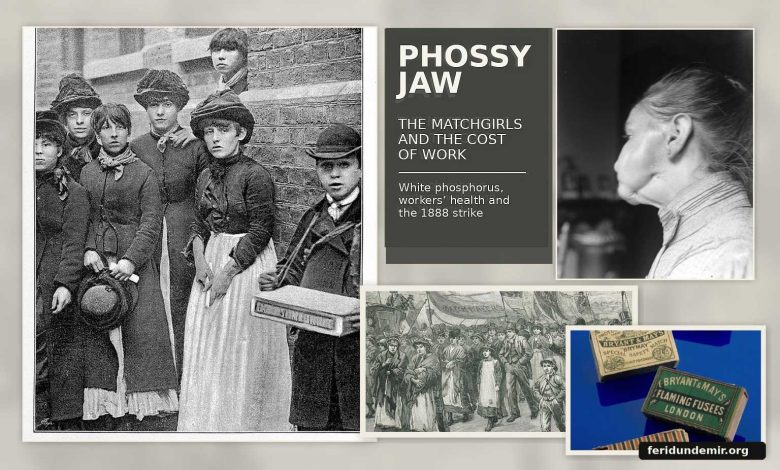
This piece began with an old photograph I came across on social media. The caption claimed that the young women in it had worked in 19th-century match factories and had lost parts of their jaws after prolonged exposure to white phosphorus. The photograph itself was difficult to verify. But the deeper I looked, the clearer it became that even if the image was questionable, the world it pointed to was not.
And the subject was too serious to scroll past with a quick “what terrible times those were.”
This is, after all, a site mostly about cartoons, cartoonists, and visual satire. But once I came across jaw necrosis, osteomyelitis, and sequestration, my curiosity as a veterinarian took over. Then another question followed, this time from a socialist point of view: why does a form of production continue for years after it is known to make people ill?
The cartoonist in me put it more simply:
Why was it the worker’s jaw that rotted, and not the company’s balance sheet?
The disease became known as phossy jaw — phosphorus necrosis of the jaw.
In the 19th century, match production commonly relied on white, or yellow, phosphorus, a highly reactive form of the element. Workers employed in mixing, dipping, drying, and other parts of the production process could be exposed to it for long periods. Bryant & May’s factory in Bow, East London, became one of the best-known examples.
Saying that phosphorus simply “rotted the jaw” is vivid, but medically it is too crude.
Bone is living tissue. Once its blood supply is compromised, and once the oral flora become involved, the condition can progress to chronic osteomyelitis. Historical cases often began with something as ordinary as toothache or a dental extraction. The socket would fail to heal, the bone would lose vitality, infection would set in, and dead fragments of bone would begin to separate from viable tissue. Sequestration, draining fistulas, purulent discharge, foul odour, loosening teeth, and severe facial deformity could follow.
None of these are unfamiliar concepts to a veterinarian. But reading them in the context of young women working in match factories 130 years ago gives them a different weight.
Ralph Stockman’s 1899 work was among the early attempts to understand the relationship between phosphorus exposure and disease of the jaw. Physicians of the period did not interpret every part of the condition in the way we would today, but by then the connection between phosphorus and the damage seen in workers was becoming impossible to dismiss.
There was also the question of how exposure occurred. In addition to inhalation, contemporary investigations considered the possibility that phosphorus could be transferred to the mouth on contaminated hands. In other words, the air inside the factory may not have been the only problem. Whether a worker could wash properly before eating may also have mattered.
By the end of the 19th century, this was no longer an entirely mysterious disease. There were patients, medical reports, factory inspectors, parliamentary questions, and legal obligations to report cases of phosphorus poisoning.
And yet the problem continued.
The issue was not simply that some cases were hidden from the authorities. There were reported cases, medical evidence, and proposed preventive measures. In 1898, proceedings involving Bryant & May revealed that a number of cases had not been reported. That was serious, but the larger fact was harder to ignore: the danger was known, and white phosphorus remained in use for years.
The proposed precautions were hardly futuristic. Better ventilation, washing facilities, dental examinations, removing affected workers from dangerous tasks, reducing exposure, and replacing hazardous materials with safer ones were all discussed.
But recognising the problem did not mean it was quickly solved. Safer production was not only a technical matter. It also had a price, affected competitiveness, and depended on how willing employers were to change their production methods.
The great Bryant & May strike of 1888 took place in this same world. It is now usually remembered as the Matchgirls’ Strike, but it would be misleading to reduce the strike to phossy jaw alone.
The women walked out over low pay, fines, wage deductions, and working conditions. Around 1,400 women and girls left the factory. Later research also challenged the older, more comfortable version of the story in which an outside reformer simply arrived and organised a passive workforce. The women themselves were at the centre of the strike and of their own organisation.
That matters, because telling their story only as one of sick, helpless young women erases half of it.
Their jaws were being damaged, but they could speak.
And they did.
The strike led to improvements in the system of fines and deductions, strengthened organisation among the workers, and became an important moment in the history of the British labour movement.
White phosphorus, however, did not disappear overnight. The existence of safer alternatives, growing medical evidence, and new rules on workers’ health did not immediately transform production. The path towards banning white phosphorus matches took years, and arguments about international competition formed part of that delay.
This is where the story began to feel less comfortably historical. The subject was no longer simply the brutality of a 19th-century workplace. It was also about how long a known health risk can remain acceptable when economic interests are involved.
Looking at working life today, we are obviously not looking at the same factories, the same disease, or the same legal environment. More than a century of progress in occupational safety, labour law, toxicology, and the recognition of occupational disease has changed a great deal. Child labour laws were introduced, trade union rights expanded, and the idea that damage to a worker’s health is simply part of the job has been challenged in ways that would have been unimaginable to many 19th-century workers.
Most of those changes did not happen by themselves. People struck, organised, went to court, wrote, marched, and refused to accept what had previously been treated as normal.
So it would make little sense to describe working life today as if it were simply Bryant & May in modern clothing. But it is not so easy to leave the story in the past.
Occupational disease has not disappeared. According to the International Labour Organization’s global estimates, around 2.93 million people die every year from work-related causes, and roughly 89 percent of those deaths are linked not to workplace accidents but to work-related diseases.
So occupational disease is hardly just a relic of the industrial past.
With phossy jaw, the damage could become horribly visible in a worker’s face. Many modern occupational diseases are less immediate. The gap between exposure and illness can be years or even decades. Asbestos is one of the clearest examples: some asbestos-related diseases may not appear until 10 to 50 years after exposure. By the time a worker becomes ill, they may have left the job long ago. Sometimes the factory itself no longer exists.
Many occupational diseases today are harder to see than a deformed jaw in a Victorian photograph.
Child labour figures make it equally difficult to say that the old world has entirely disappeared. According to 2024 estimates from the ILO and UNICEF, around 138 million children are still in child labour worldwide, and about 54 million of them are engaged in work considered hazardous to their health or safety.
After numbers like these, it becomes harder to look at an 1888 factory photograph and say only, “what terrible times those were.”
A great deal has changed, but conflicts between workers’ health and the demands of production have not disappeared.
From a medical point of view, phossy jaw is no longer especially mysterious. What remains more disturbing is what happened after the damage was recognised.
At Bryant & May, the disease was known. Cases had been recorded. Preventive measures had been proposed. The failure to report some cases made the story worse, but it was not the whole story.
And it would be unfair to remember these women only through their illness. When they went on strike in 1888, they were not passive victims of their working conditions. They challenged wages, fines, and the organisation of work. They organised, negotiated, and forced their employer to respond.
Phossy jaw is now largely a subject for medical history. White phosphorus matches belong there too. But the questions raised by the story did not disappear with the disease. When a job is known to damage human health, what happens next, how long change is delayed, and who is expected to bear the cost are still with us.
That is why, when I look at those old photographs now, simply saying “what terrible times those were” no longer feels enough.
<button swg-standard-button="contribution"></button>Share this content:
Discover more from Feridun Demir
Subscribe to get the latest posts sent to your email.