The Global Memory of the Line – 5 | The New Yorker and the Art of the Single-Panel Cartoon

How a Manhattan magazine transformed cartooning from public spectacle into a compact form of social observation, verbal precision and visual wit.
This article is the fifth part of “The Global Memory of the Line,” a series exploring the historical development of cartoon and satire magazines around the world.
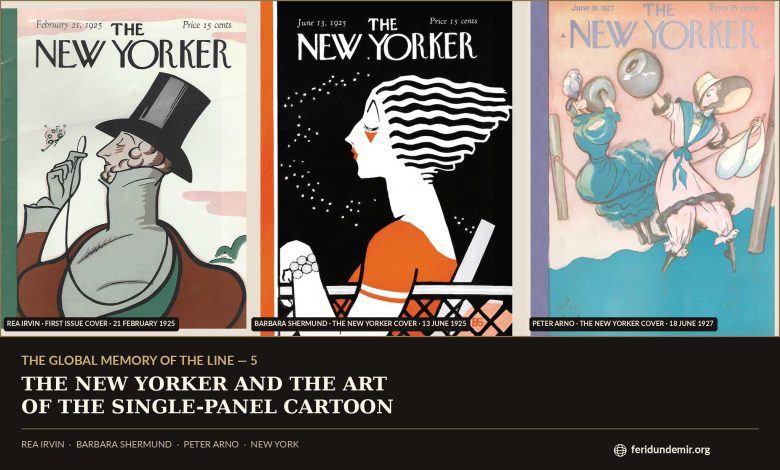
In February 1925, a thin man in a top hat lifted a monocle towards a butterfly. He was not a president, senator or industrial magnate. He did not stand beneath an allegorical banner or beside a gigantic monopoly. Nothing in the scene suggested the grand political theatre that had dominated so much nineteenth-century satire. The figure simply looked.
Rea Irvin had drawn him for the cover of the first issue of a new magazine called The New Yorker. The character would later become known as Eustace Tilley, and the combination of elaborate dress, monocle and butterfly established a visual attitude that survived far beyond the Jazz Age. Irvin, the magazine’s first art editor, used the image to announce a different kind of satirical publication: one interested less in monumental political allegory than in observation, style and the quiet absurdities of modern urban life.
Where Puck had enlarged politics until senators, corporations and nations filled theatrical double-page spreads, The New Yorker often moved in the opposite direction. It brought satire into offices, apartments, restaurants, cocktail parties, bedrooms and psychiatrists’ rooms. A single exchange between two anonymous people could reveal class anxiety, professional hierarchy, marital tension or cultural pretension. The political cartoon had traditionally asked what was wrong with government. The New Yorker cartoon increasingly asked what was wrong with people, and sometimes discovered that one small social gesture contained an entire social system.
A Magazine for Metropolitan Life
Harold Ross founded The New Yorker in 1925 with the intention of creating a publication that reflected the tone and intelligence of metropolitan life. The magazine was conceived for readers who understood—or wished to understand—the codes of New York rather than for a broad national audience requiring every joke to be explained.
That assumption shaped its humour from the beginning. A caption could depend on familiarity with restaurants, publishing, theatre, apartment living, office hierarchy, psychiatry or fashionable language. A drawing could show two affluent people behaving badly without identifying them as symbols of wealth. The reader was expected to recognise the type, understand the setting and supply part of the interpretation.
This created a new intimacy between publication and audience. Earlier political satire often pointed outward towards a visible target: a corrupt senator, a king, a party boss or a monopolist. The New Yorker cartoon frequently turned the joke inward. It suggested that the ridiculous person might be someone the reader knew, worked with, lived with or perhaps resembled.
A Comic Paper Before a Cultural Institution
The prestige that later surrounded The New Yorker can obscure how uncertain and modest its beginnings were. Ross himself described the project as a “fifteen-cent comic paper.” The magazine would eventually become internationally known for journalism, fiction, criticism and literary writing, but cartoons were not a secondary addition to an already serious publication. They were central to its identity from the beginning.
The drawings quickly became one of its most distinctive features. They provided the magazine with a recognisable personality before many of its later literary traditions had fully developed. The cartoons also allowed The New Yorker to create a tone that was difficult to achieve through prose alone: sophisticated without being solemn, ironic without always becoming openly aggressive, and socially observant without requiring a political manifesto.
Rea Irvin and the Visual Voice of the Magazine
Rea Irvin’s importance extended far beyond the creation of Eustace Tilley. As the magazine’s first art editor, he helped establish the visual language through which covers, cartoons, typography and illustration would coexist.
The first cover was particularly effective because it did not behave like an advertisement. Eustace Tilley did not shout or perform for the audience. He observed. His exaggerated elegance suggested both sophistication and ridiculous self-importance, while the monocle implied close examination of an object that might not deserve such seriousness. The butterfly became almost secondary to the act of looking.
This tension between seriousness and absurdity became central to the magazine. Culture itself could become comic material. The cultivated person could be ridiculous precisely because he was cultivated. The observer was not automatically wiser than the object being observed.
That distinction separated The New Yorker from publications that built their identity around heroic reformers or aggressive satirical mascots. Its tone was less that of a crusader and more that of a highly attentive witness.
The Cartoon Leaves the Political Stage
The major nineteenth-century satirical magazines often relied on allegory. Nations became women, lions or mythological figures. Corporations became monsters. Political parties became damaged vehicles, theatrical companies or armies. These devices transformed complex systems into visible bodies.
The New Yorker cartoon usually required less machinery. A drawing could show two ordinary people in a room and still contain a complete social argument. Class could be revealed through furniture. Gender could be exposed through a single line of dialogue. Authority could be expressed through the size of an office, the position of a desk or the fact that one person sat while another remained standing.
This did not mean that the cartoons became apolitical. Rather, politics moved into the structures of everyday life. Power could be found in manners, employment, marriage, taste, professional language and access to social spaces. The large public institution was no longer the only place where hierarchy could be observed.
The scale changed, but the satirical function remained.
The Single-Panel Form
One of the forms most strongly associated with The New Yorker became the single-panel cartoon with a short caption. The drawing created a situation; the caption altered the meaning of that situation. Neither necessarily contained the entire joke by itself.
The best cartoons often produced a small delay in understanding. The reader first saw the image, then read the sentence and then mentally returned to the image. Meaning emerged in the movement between those two moments.
A businessman speaking to another businessman might appear ordinary until the caption revealed an impossible assumption. A married couple might sit calmly together while one sentence exposed years of resentment. A doctor might appear authoritative until a phrase revealed vanity or incompetence.
This interaction between image and language gave the New Yorker cartoon a peculiar precision. The drawing did not merely illustrate the caption, and the caption did not simply explain the drawing. Each created a gap that the other completed.
Peter Arno and the Stylish Satirist
Peter Arno became one of the defining cartoonists of the magazine’s early decades. His world was populated by wealthy men, nightclubs, hotel rooms, expensive restaurants, drawing rooms and social events. His characters often possessed money, confidence and social position, but these advantages did not protect them from embarrassment.
Arno’s line was energetic and theatrical. His figures seemed designed for performance, which made their failures especially satisfying. The people in his cartoons often looked as though they understood the rules of society perfectly. The caption revealed that they did not.
His humour was frequently sexual, social and class-conscious. Respectable behaviour could collapse in a moment. Wealth could become absurdity. Sophistication could become incompetence. The comedy emerged from the distance between appearance and reality.
Arno’s work helped establish one major tradition within New Yorker cartooning: elegant social satire in which stylish drawing made human foolishness appear even sharper.
James Thurber and the Opposite Tradition
James Thurber represented almost the opposite visual tendency. His drawings could appear awkward, fragile or technically uncertain. Bodies leaned strangely. Dogs looked anxious. Rooms seemed psychologically unstable. Men often appeared confused by their surroundings, while women could seem more physically and emotionally certain than the men beside them.
The apparent weakness of the drawing was part of its expressive power. Thurber demonstrated that a cartoon did not need academic polish in order to be visually convincing. Perspective could be imperfect, anatomy could be simplified and lines could seem tentative as long as the image carried a distinctive intelligence.
This was an important shift in the history of cartooning. The artist no longer needed to prove technical mastery in the traditional illustrative sense. The line could be personal, nervous, clumsy or deliberately crude if it conveyed the right emotional reality.
A Thurber dog did not need to resemble a real dog. It needed to resemble the psychological condition of being that particular dog.
The Freedom of Imperfect Drawing
Thurber’s example helped legitimise one of the most important freedoms in modern cartooning: the right to draw badly in a meaningful way.
This distinction separated cartooning from conventional illustration. Illustration often demonstrated the artist’s ability to reproduce a scene convincingly. Cartooning could refuse realism altogether. Its truth did not depend on accurate anatomy or perspective. It depended on recognition.
A technically incomplete line could communicate personality more effectively than a polished rendering. A strange posture could reveal insecurity. A distorted room could express emotional disorder. An awkward figure could feel more human precisely because it was not idealised.
This freedom widened the range of artists who could contribute to magazine cartooning and helped move the form towards greater stylistic diversity.
Helen Hokinson and the Social Type
Helen Hokinson developed another important strand of New Yorker humour. Her drawings often focused on middle-class and upper-middle-class women engaged in clubs, lectures, charity work, cultural organisations and civic activities.
The humour was frequently affectionate rather than cruel. Her characters wanted to be informed, cultured and useful. Their seriousness could become comic when enthusiasm exceeded understanding, but the drawings also documented a genuine transformation in women’s social participation.
These women organised, attended public events, consumed art and created networks. They were not simply domestic figures. The joke might expose pretension, yet the social world behind the joke reflected changes in American public life.
Hokinson’s work therefore operates on two levels. It is comic, but it is also documentary. Her cartoons preserve the behaviour, language and ambitions of a specific class and generation.
Barbara Shermund and Modern Women
Barbara Shermund brought a sharper and often more independent female voice to the magazine. Her cartoons addressed dating, marriage, sexuality and changing gender expectations. Women in her drawings could be self-aware, impatient, independent and openly critical of the roles assigned to them.
This complicated the idea that early New Yorker humour belonged only to male observers describing female social behaviour. The magazine’s first generations included several women whose work interpreted modern urban life from different perspectives.
Shermund, Hokinson and Mary Petty did not form a unified “female style.” Their importance lies precisely in their differences. Together they demonstrated that the modern social cartoon could be produced from multiple positions within the same culture.
Charles Addams and the Domestic Nightmare
Charles Addams introduced another world into the magazine: the respectable interior in which something had gone terribly wrong.
A house looked comfortable. Then the reader noticed a weapon, trap, monster or architectural impossibility. A family gathered in an ordinary room. Then one detail transformed the scene into a nightmare.
Addams understood the comic power of normality. The safer the room appeared, the darker the joke could become. Horror did not enter from outside. It already lived comfortably within domestic life.
This was more than a combination of horror and humour. Addams used the macabre to expose the strangeness hidden inside supposedly ordinary families, homes and routines. The respectable house became a stage on which violence, resentment and eccentricity could exist without disturbing the furniture.
The Office as a Theatre of Power
The modern office became one of the most durable settings in New Yorker cartooning because it concentrated hierarchy, language and social performance within a small physical space.
A desk could represent authority. A large office could represent status. A closed door could mean exclusion. A secretary, applicant, middle manager or salesman could be placed instantly within a recognisable chain of power.
Corporate language also became a particularly productive source of humour. Bureaucracies developed phrases that sounded important while often saying very little. Managers learned to replace simple statements with abstractions. Employees used professional language to protect themselves from responsibility.
Cartoonists discovered that modern organisations frequently generated their own captions.
The workplace cartoon became effective because it rarely required an explanation of the entire corporation. A single conversation could reveal the hierarchy behind it.
The Psychiatrist’s Couch
Few settings became as closely associated with twentieth-century magazine humour as the psychiatrist’s couch.
Psychoanalysis created a perfect visual structure for the single-panel form. One person spoke. Another listened. One was vulnerable; the other possessed professional authority. A single sentence could reverse the relationship.
The patient might reveal something absurd. The therapist might misunderstand the patient. The therapist might prove to be stranger than the person seeking help.
The couch also expanded the territory of acceptable humour. Fear, sex, childhood, ambition, anxiety, marriage and self-deception could become subjects of public comedy.
The mind itself became a setting.
The Restaurant Table and Social Performance
Restaurants offered another ideal stage. Two people seated at a table created a complete social world.
They might be dating, breaking up, negotiating business, pretending to enjoy expensive food or trying to impress the waiter. The setting contained class signals in concentrated form: clothing, menu language, service, price, taste and etiquette.
A person did not need to lose an election or a fortune in order to become ridiculous. Ordering the wrong wine, misunderstanding the menu or saying the wrong thing at the wrong moment could be enough.
The New Yorker cartoon understood that modern identity was performed through countless small situations. Its humour often captured the instant when the performance failed.
Humour as a Social Code
This dependence on social knowledge sometimes made New Yorker cartoons difficult for readers who did not share the assumed cultural world.
A joke might depend on knowing a particular profession, manner of speaking, artistic fashion or social convention. Without that knowledge, the drawing could appear obscure.
The difficulty became part of the magazine’s identity. Understanding the cartoon could itself become a sign of belonging.
This created a subtle cultural hierarchy. Humour built a community among readers who recognised the codes, but it could also mark outsiders. Sophistication became both the subject of satire and one of the conditions for understanding it.
The magazine could mock elite behaviour while assuming an audience familiar with elite culture.
That contradiction remained productive for decades.
Editorial Selection and the New Yorker Cartoon
The familiar idea of a “New Yorker cartoon” did not emerge because all its artists drew alike. In fact, they often looked radically different from one another.
What created continuity was editorial selection.
Cartoonists submitted large numbers of drawings. Editors chose only a small percentage. Over time, this filtering process established a shared set of expectations: economy, indirection, social observation, caption precision and confidence that the reader would complete part of the joke.
This is one of the magazine’s central institutional achievements.
A strong publication does not need to force every artist into one style. Instead, it can create a context within which very different styles seem to participate in the same intellectual conversation.
Saul Steinberg and the Line That Thinks
Saul Steinberg expanded the possibilities of New Yorker cartooning more radically than almost anyone else.
His drawings often escaped the conventional gag structure. A line could become a wall. A signature could become architecture. A map could become psychology. A person might be defined not by anatomy but by the shape of a speech balloon or by the system of symbols surrounding him.
Steinberg treated drawing as a language capable of examining itself.
The pen did not simply describe the world. It questioned the conventions through which the world was represented.
This shifted the cartoon towards conceptual art. Humour remained present, but it no longer had to resolve into a conventional punch line. A drawing could be funny, philosophical, ambiguous and formally inventive at the same time.
From Gag to Visual Thought
Steinberg’s work demonstrated that a cartoon could function as a form of thought rather than merely as a vehicle for a joke.
A few marks might establish a problem involving identity, borders, language, class or representation. The line itself could become the subject.
This expanded the cultural status of magazine cartooning. The work could exist between caricature, conceptual art, illustration and graphic design. The distinction between “high” and “low” visual culture became increasingly unstable.
Steinberg used the apparently modest medium of the magazine page to ask questions normally associated with modern art.
The result was one of the clearest examples of the cartoon becoming not only a commentary on society, but a commentary on seeing.
View of the World from 9th Avenue
One of Steinberg’s most famous images appeared as a New Yorker cover in 1976.
View of the World from 9th Avenue presented Manhattan in great visual detail in the foreground. Beyond the Hudson River, the rest of the United States rapidly contracted. The Pacific appeared close, and distant countries were compressed near the horizon.
The image was not really a geographical map. It was a map of attention.
New York appeared large because New Yorkers experienced it as large. Everything else became smaller because it occupied less mental space.
The cartoon returned to a principle already familiar from Keppler: physical scale could represent invisible power. But Steinberg changed the subject. The distortion no longer described corporate or political influence. It described perception itself.
The City as a Character
New York was never merely the location of the magazine. It became one of its central characters.
The city appeared through elevators, subways, offices, taxis, museums, restaurants, theatres, apartment buildings and crowded sidewalks. These places produced recurring types and situations that eventually became recognisable far beyond Manhattan.
The cramped apartment, ambitious professional, impatient waiter, neurotic intellectual and exhausted commuter entered an international visual vocabulary.
Cartoons turned local detail into portable social knowledge.
A reader who had never visited New York could still learn to recognise the mythology of the city through its drawings.
George Price and the Architecture of Chaos
George Price developed a visual world that differed sharply from Steinberg’s economy.
His rooms could become impossibly crowded. Furniture accumulated. Architecture bent. Objects collided. Domestic space seemed to have grown without planning.
Yet the people inside often behaved calmly.
That calmness intensified the absurdity.
The environment suggested disaster, but the characters had adapted.
This produced another important New Yorker mechanism: the abnormal situation treated as normal by the people inside it.
The reader becomes the only person who understands that something is wrong.
Satire Without a Clear Victim
Traditional political caricature frequently depends on attack. A king, minister, party boss, corporation or enemy stands at the centre of the joke.
The New Yorker cartoon often works differently.
Sometimes there is no clear victim at all.
Both people misunderstand each other. Everyone in the room is trapped by the same convention. The individual is not evil or corrupt. He is simply absurd.
This changes the moral temperature of the cartoon. The humour may remain cruel, but the cruelty is distributed more widely.
Political caricature often says:
They are ridiculous.
Social cartooning can say:
We are ridiculous.
That difference helps explain the intimate quality of the New Yorker tradition.
The Universal Through the Specific
The strongest New Yorker cartoons often begin with extremely specific settings: a Manhattan office, a cocktail party, a therapist’s room or an expensive restaurant.
Yet the emotions beneath them travel easily.
Ambition, fear, loneliness, status anxiety, marital tension, professional insecurity and the desire to appear intelligent are not uniquely New York experiences.
The local detail makes the scene convincing.
The underlying anxiety makes it universal.
This may be one reason the New Yorker model became internationally influential. Cartoonists elsewhere did not need to reproduce Manhattan society. They could adopt the compact single-panel structure and replace the local content with their own social environment.
The form travelled even when the city did not.
The Cartoonist as Social Anthropologist
The New Yorker cartoonist often behaves like an anthropologist studying rituals.
Who enters the room first? Who sits at the head of the table? Who pays? Who apologises? Who pretends to understand the art? Who controls the conversation? Who says the wrong thing?
The difference is that the cartoonist compresses the observation into one moment.
A culture often reveals itself when someone violates a small rule.
This form of humour depends less on spectacle than attention. The artist watches what people do when they believe nothing important is happening.
Frequently, that is where the important thing is happening.
The Myth of Timelessness
New Yorker cartoons are often described as timeless, but no cartoon exists entirely outside history.
Clothing changes. Offices change. Marriage changes. Gender roles change. Language changes. Psychiatry changes. Technology changes.
A joke about a secretary, servant or housewife may depend on assumptions that later generations no longer share.
This gives the archive a double function.
The cartoon may still be funny, but it also becomes evidence of the social structure that made the joke possible.
The drawing preserves not only humour, but expectation.
Who Gets to Be Ordinary?
This question becomes especially important when examining class, race, gender and sexuality.
The magazine’s early ideal reader emerged from a relatively narrow metropolitan social world. Affluent white professional life was frequently treated as the default setting, while others could appear as servants, stereotypes, outsiders or people requiring explanation.
Over time, the publication changed as American society changed and as its contributor base expanded.
But the archive preserves the original boundaries.
Satire always defines normality.
The figure who requires no explanation often tells us more about the imagined audience than the figure who becomes the joke.
From Weekly Feature to Cultural Institution
By the middle of the twentieth century, the New Yorker cartoon had become an institution in its own right.
Readers encountered the drawings every week. Collections circulated beyond the magazine. Individual images were clipped, framed and remembered.
Eventually, cartoons from the publication formed a recognised cultural category. A drawing could be described as “New Yorker-style” even if it had never appeared in the magazine.
That phrase suggested more than visual appearance.
It implied a compact social situation, a short caption, indirection and the expectation that the reader would participate in completing the joke.
The magazine had transformed an editorial convention into a genre.
The Problem of Formula
Success produced imitation, and imitation produced formula.
The businessman behind the desk, the patient on the couch, the couple in bed, the castaways on the island, the dog speaking to another dog and the cocktail party became familiar New Yorker settings.
Eventually these situations could themselves become the subject of parody.
A genre survives only if artists continually renew its conventions.
This is one of the hidden difficulties of the single-panel cartoon. The setting must be familiar enough to be understood immediately, but the thought must remain unfamiliar enough to justify the drawing.
Simplicity increases the pressure on every element.
There is nowhere for weakness to hide.
The Caption Contest and the Reversal of Authorship
The magazine later transformed the relationship between image and caption into a public game through its Cartoon Caption Contest.
Readers were shown a drawing without a caption and invited to submit their own lines.
The format revealed something fundamental about the single-panel cartoon.
One image can contain many possible jokes.
The caption does not merely explain the drawing. It selects one interpretation from a field of possibilities.
By allowing thousands of readers to propose alternatives, the contest exposed part of the invisible labour normally performed by cartoonists and editors.
The same image could become political, domestic, absurd, philosophical or childish depending on one sentence.
Authorship temporarily moved from artist to audience.
A Century of Cartoons
By 2025, The New Yorker had reached its hundredth anniversary.
Across that century, the media environment had been transformed by radio, television, photography, digital publishing and social platforms.
Yet the single-panel cartoon survived.
Its material requirements remained remarkably modest: a rectangular space, a few lines and, often, one sentence. That economy gave the form extraordinary flexibility.
The cartoon could adapt to new technologies, new workplaces, new relationships and new cultural anxieties without abandoning its basic structure.
Its small scale became a source of resilience.
What The New Yorker Changed
The New Yorker did not invent the single-panel cartoon, but it built one of the most durable editorial cultures around it.
It demonstrated that a cartoon could expose social systems without drawing politicians, that a short caption could carry as much weight as a large political allegory, and that technical imperfection could become a powerful personal language.
It turned the ordinary interior into a satirical stage and made the reader part of the joke rather than a safe observer standing outside it. It allowed very different drawing styles to coexist within one strong editorial identity and created space for the cartoon to move between humour, illustration, conceptual art and philosophy.
Most importantly, it changed the scale of satire.
Keppler had filled the page with institutions.
Steinberg could transform the world with a line.
From Sophisticated Wit to Deliberate Stupidity
By the middle of the twentieth century, the New Yorker cartoon represented one of the most refined traditions in American magazine humour. Its jokes depended on understatement, social knowledge and precision. Its artists learned how much could be removed from an image without losing meaning.
Then another publication arrived with almost the opposite philosophy.
It would not whisper.
It would parody advertising, comic books, movies, television and consumer culture with deliberate noise, distortion and bad taste.
Instead of an elegant observer studying a butterfly through a monocle, its most famous face would be a gap-toothed boy whose expression suggested that modern society was too ridiculous to deserve seriousness.
His name was Alfred E. Neuman.
The magazine was MAD.
Previous in the series:
Next in the series:
The Global Memory of the Line – 6: MAD and the Satire of American Mass Culture
Share this content:
Discover more from Feridun Demir
Subscribe to get the latest posts sent to your email.