The Bold Legacy of Nicole Hollander: The Feminist Trailblazer Behind “Sylvia” Dies at 86

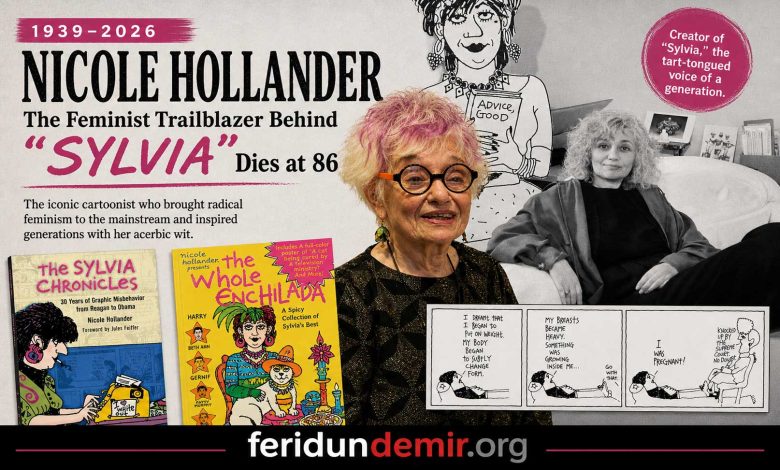
The world of satire and graphic arts is mourning the loss of Nicole Hollander, the acerbic cartoonist who spent over three decades dismantling the patriarchy with nothing but a pen and a well-timed punchline. Hollander, best known as the creator of the iconic comic strip “Sylvia,” passed away on April 23, 2026, in Chicago. She was 86.
Her executor, Tom Greensfelder, confirmed her passing at an assisted-living facility. While she had been battling dementia and respiratory issues, those close to her noted that her creative spark remained undimmed until the very end.
Sylvia: The Bathtub Philosopher
When “Sylvia” debuted in 1980, the “funny pages” were dominated by domestic humor and gentle gags. Hollander introduced something radical: a protagonist who was a big-haired, cigarette-smoking, hyper-opinionated feminist who often commented on the world’s failings while lounging in her bathtub.
Sylvia was a singular force for several reasons:
- Mainstreaming Radicalism: Hollander took the intellectual, biting feminism of underground publications and smuggled it into nearly 80 mainstream daily newspapers, including the Los Angeles Times and the Chicago Tribune.
- Fearless Commentary: Nothing was off-limits. From the Reagan administration’s policies to the glass ceiling, health care reform, and the environmental crisis, Sylvia provided a “tart-tongued” reality check for readers.
- The “Everywoman” Wit: Despite her sharp edges, Sylvia resonated because she felt real. She was a single mother and an observer of the mundane, finding the absurdity in everything from dating to grocery shopping.
“Nicole’s M.O. is that when it comes to powerlessness she performs as critic and collaborator, pacifist and bomb-thrower… She is a radical social critic who is certain that nothing works, and so what? — a revolutionary who believes in the hell with it, I’m going shopping.” — Jules Feiffer
From the West Side to the National Stage
Born in Chicago in 1939, Hollander’s humor was forged in the kitchens and delis of her childhood. She often credited her mother and her mother’s friends—women who were irreverent, backbiting, and hilariously blunt—as the true blueprints for Sylvia.
After earning a Bachelor of Fine Arts from the University of Illinois and an MFA from Boston University, Hollander briefly worked a series of odd jobs before finding her calling in feminist media. As a graphic artist for the magazine The Spokeswoman, she began sketching “Feminist Funnies,” the precursor to Sylvia.
In 1979, she published “I’m Training to Be Tall and Blonde,” a book that challenged the beauty standards of the era. Shortly after, “Sylvia” was syndicated, and Hollander became a rarity: a successful woman in the male-dominated field of daily comic strips.
A Lasting Influence on Modern Satire
Hollander’s “loose” drawing style—reminiscent of Jules Feiffer—paved the way for a new generation of graphic storytellers. Alison Bechdel (Fun Home) and Liza Donnelly (The New Yorker) have cited her as a crucial influence.
Her work extended beyond the newsprint:
- Collections: She published more than a dozen books, including the comprehensive The Sylvia Chronicles: 30 Years of Graphic Misbehavior from Reagan to Obama.
- Theater: She co-wrote two musical comedies, Sylvia’s Real Good Advice and Female Problems, bringing her character’s wit to the stage.
- Memoir: In 2018, she released We Ate Wonder Bread, a graphic memoir detailing her upbringing in a Jewish neighborhood on Chicago’s West Side.
Final Years: Art Against the Odds
Even as dementia began to cloud her memory, it could not stop her hand from drawing. In her final years at an assisted-living center, Hollander continued to produce art. Her later works shifted toward the surreal—moving away from defined characters like Sylvia and into a space of “odd but beautiful” abstract forms. She even held a final gallery show for her fellow residents, proving that her identity as an artist was inseparable from her soul.
Nicole Hollander didn’t just draw cartoons; she drew a roadmap for how to navigate a world that often refuses to listen to women. As Sylvia herself famously said when asked about a world without men: “No crime and lots of happy, fat women.”
She is survived by her sister, Jana Carpenter, and a generation of readers who learned how to laugh at the powerful thanks to her pen.
Share this content:
Discover more from Feridun Demir
Subscribe to get the latest posts sent to your email.