(Note: This post contains affiliate links. If you make a purchase through these links, I may earn a small commission at no extra cost to you. Thank you for supporting the content on feridundemir.org!)
Long before architectural criticism found its way onto social media, American cartoonist Alan Dunn was using humor to expose the contradictions, obsessions, and absurdities of modern architecture.
Best known for his work in The New Yorker and Architectural Record, Dunn became one of the most insightful visual commentators on the architectural transformations that reshaped America during the mid-20th century. Through sharp satire and deceptively simple drawings, he captured the public’s fascination, confusion, and sometimes outright hostility toward modernist design.
A Unique Observer of Architectural Change
Alan Dunn’s relationship with architecture was unusual. Trained as an artist in the United States, Italy, and France, he never became an architect himself, yet he understood the profession well enough to critique it with remarkable precision.
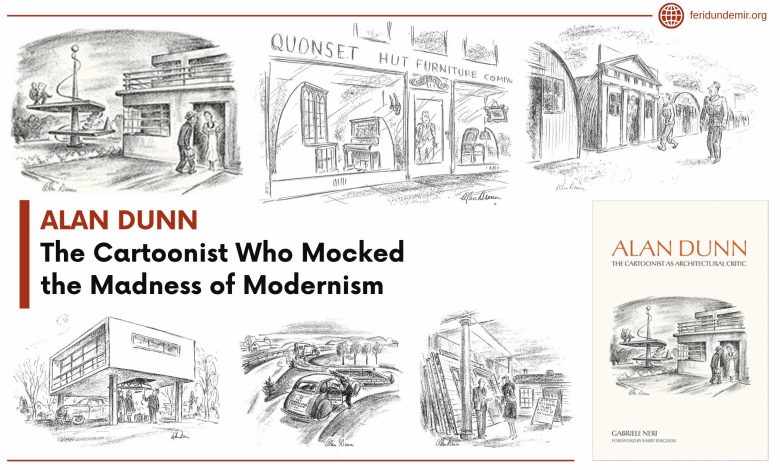
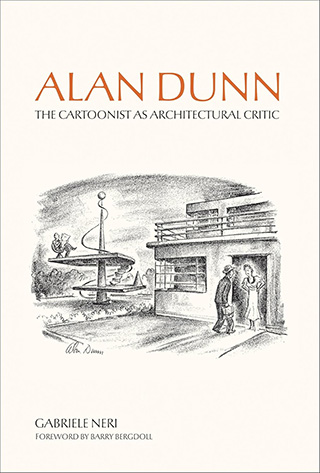
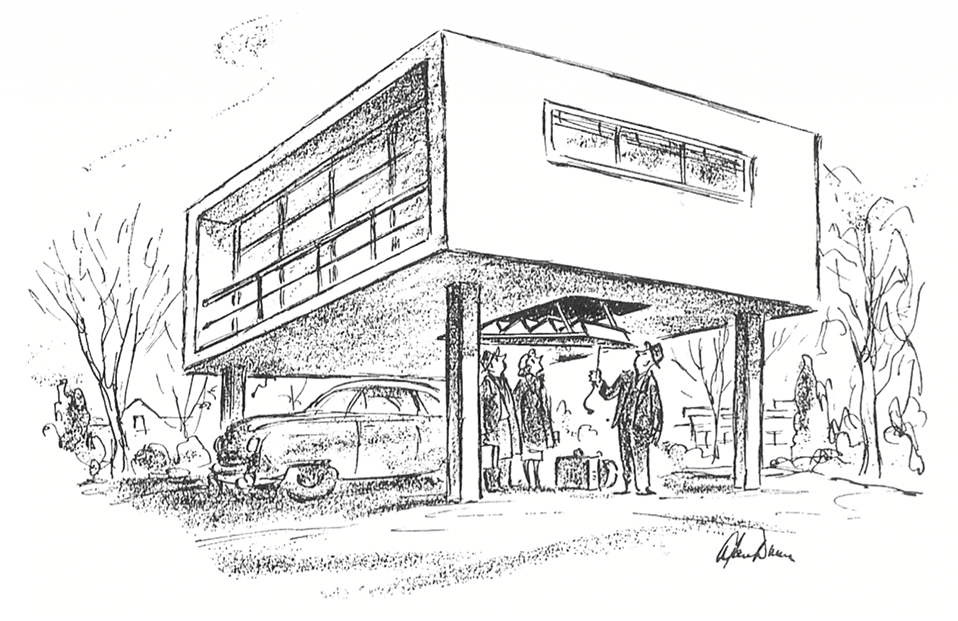
His first cartoon for Architectural Record appeared in 1936 and immediately demonstrated the themes that would define his career. The drawing featured two neighboring houses: one a fashionable modernist residence, the other an absurdly radical structure reduced to little more than a platform suspended in space.
The joke highlighted a question many Americans were already asking: How far could modern architecture go before it became detached from everyday life?
Modernism as Fashion
Throughout his career, Dunn suggested that modern architecture was not merely a technological or cultural revolution but also a constantly changing fashion.
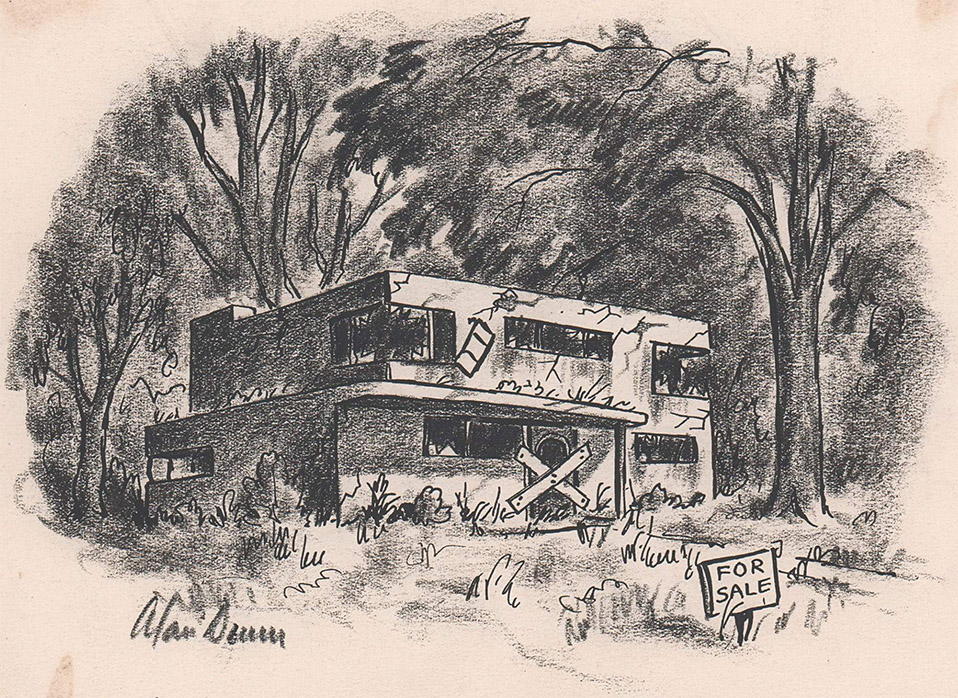
His cartoons often portrayed modernist buildings as temporary trends rather than timeless achievements. In one memorable drawing, a sleek International Style house stands abandoned and falling apart in the middle of a forest, complete with a “For Sale” sign. Despite the movement’s promises of progress and permanence, Dunn implied that even the newest architectural ideals would eventually become outdated.
This ability to challenge architectural dogma made his work popular with readers and sometimes uncomfortable for architects themselves.
Bringing Architectural Debates to Everyday Life
What distinguished Dunn from many critics of his era was his ability to translate complex architectural debates into scenes that ordinary people could immediately understand.
Rather than focusing on technical discussions, he placed architecture within familiar American settings—suburban neighborhoods, living rooms, construction sites, and real estate offices. In doing so, he revealed how architectural trends influenced daily life and how people reacted when confronted with unfamiliar forms and ideas.
His cartoons showed that architecture was not merely about buildings. It was about aspirations, social values, cultural identity, and changing perceptions of modernity.
Questioning Blind Faith in Technology
One of Dunn’s recurring targets was society’s unquestioning belief in technological progress.
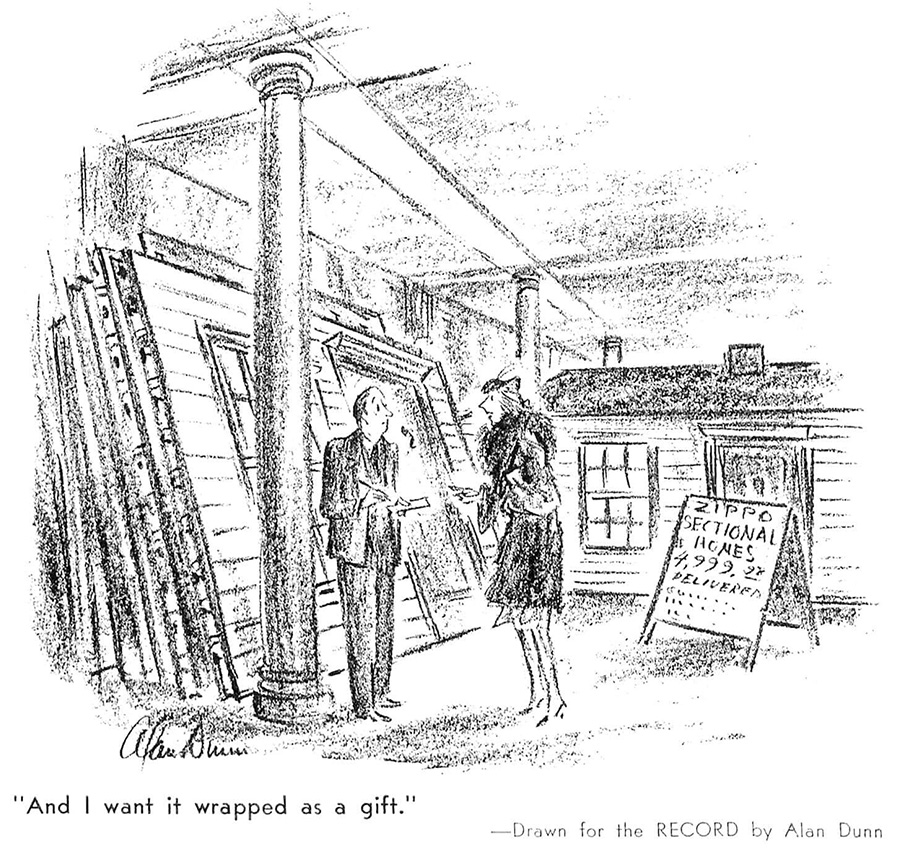
As architects and developers experimented with new materials and prefabricated construction systems, Dunn responded with cartoons that exposed the potential absurdity behind the enthusiasm.
In one famous example, a lightweight magnesium house is swept away by a storm while traditional homes remain firmly in place. Looking out of the airborne structure, the homeowner remarks that there is “one thing” he dislikes about magnesium houses.
In another cartoon, futuristic homes are built from experimental combinations of plastic, cellulose, and soybeans, reflecting the era’s fascination with industrial innovation.
Rather than rejecting technology outright, Dunn questioned whether innovation alone could solve the practical realities of human life.
Housing, Mortgages, and the American Dream
Dunn also explored the economic realities behind America’s housing boom.
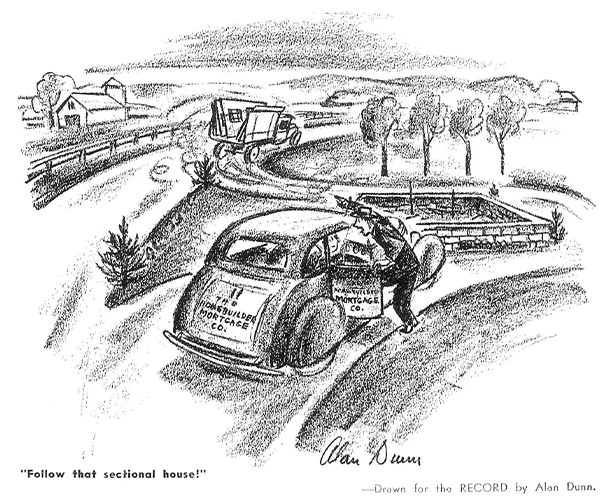
In one memorable cartoon, a representative of a mortgage company watches a prefabricated house speeding away on a truck and urgently orders his driver to follow it. The joke cleverly reflected the financial systems that underpinned the American housing market and the increasingly mobile nature of modern construction.
His humor often revealed how the dream of homeownership was tied not only to architecture but also to economics, credit, speculation, and consumer culture.
The Quonset Hut Phenomenon
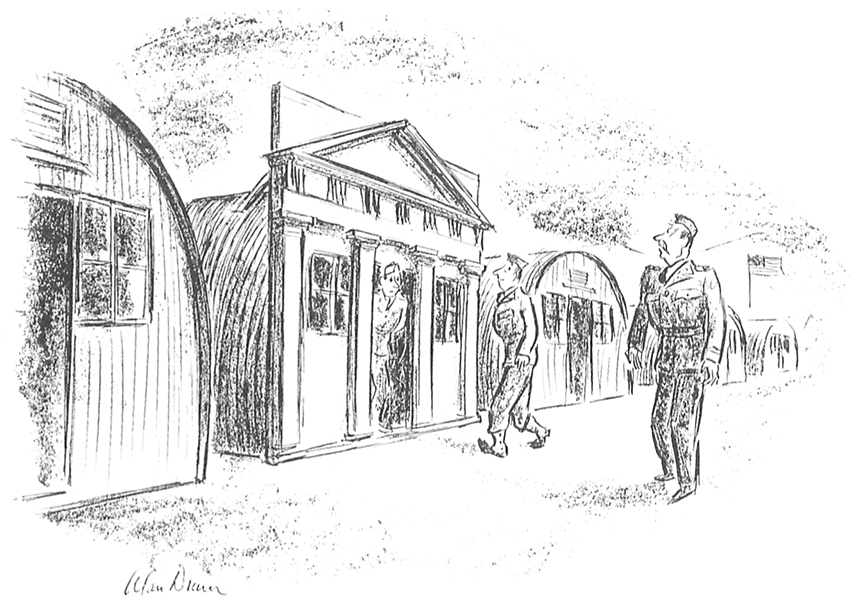
Following World War II, America faced an enormous housing shortage. One proposed solution was the civilian adaptation of military Quonset huts—semi-cylindrical prefabricated structures originally designed for rapid deployment during wartime.
During the war, approximately 170,000 Quonset huts were produced and shipped around the world. After the conflict ended, many were repurposed as emergency housing, schools, shops, offices, and even family homes.
Architects and manufacturers promoted the structures as symbols of efficiency and modern living. Yet many Americans struggled to accept these curved metal shells as genuine homes.
Dunn immediately recognized the cultural tension behind the phenomenon.
When Modern Living Meets Human Habits
The cartoonist found endless inspiration in the practical inconveniences created by these unconventional structures.
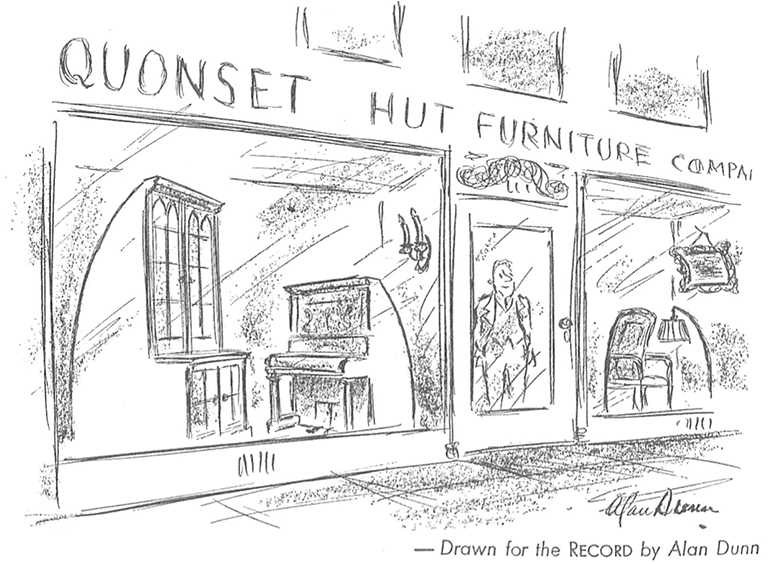
In one cartoon, a frustrated homeowner attempts to hang a painting on the curved wall of a Quonset hut, surrounded by nails and tools that prove useless. In another, a furniture showroom advertises traditional furnishings specially adapted for curved walls.
The humor reflected a broader reality: while engineers and planners focused on efficiency, ordinary people still wanted comfort, familiarity, and emotional attachment to their living spaces.
For Dunn, the conflict between technological innovation and human expectations was one of the defining stories of modern architecture.
A Sharp Eye on Architectural Obsessions
Throughout the 1940s and 1950s, Dunn chronicled the rise of the International Style and the growing influence of modernist aesthetics across the United States.
His cartoons repeatedly highlighted architecture’s tendency toward fashionable extremes. Whether mocking abstract houses, futuristic materials, or prefabricated housing experiments, he revealed how quickly certainty could become absurdity.
At a time when architects often presented modernism as an inevitable path toward the future, Dunn reminded audiences that every movement, no matter how revolutionary, contained contradictions and blind spots.
Capturing the Human Side of Modern Architecture
What made Alan Dunn exceptional was his focus on people rather than buildings.
While architects debated theories, materials, and aesthetics, Dunn observed how ordinary Americans reacted to these changes. His cartoons documented the bewilderment, nostalgia, excitement, and resistance that accompanied the rapid modernization of the built environment.
With only a few lines and a well-crafted caption, he revealed the tensions between innovation and tradition, between professional ambition and everyday experience.
His work demonstrated that architecture could never be understood solely through plans, models, and manifestos. It had to be understood through the lives of the people who inhabited it.
A Legacy That Remains Relevant
Decades after their publication, Alan Dunn’s cartoons remain surprisingly contemporary. Many of the issues he explored—technological optimism, architectural fashion, prefabrication, housing affordability, and the relationship between design and daily life—continue to shape discussions about architecture today.
His work serves as a reminder that architecture is never just about buildings. It is also about the people who inhabit them, the cultures they reflect, and the emotions they inspire.
Through humor, Alan Dunn preserved a unique visual record of America’s encounter with modernism—one that remains as insightful as it is entertaining.
Recommended Reading
Interested in learning more about Alan Dunn and the architectural world he satirized? The following book is an excellent resource for exploring his work, influence, and legacy:
Source: Adapted from an article by Gabriele Neri, architectural historian and author of the book Alan Dunn.
Amazon Associates Disclosure: feridundemir.org is a participant in the Amazon Services LLC Associates Program, an affiliate advertising program designed to provide a means for sites to earn advertising fees by advertising and linking to Amazon.com.
Share this content:
Discover more from Feridun Demir
Subscribe to get the latest posts sent to your email.