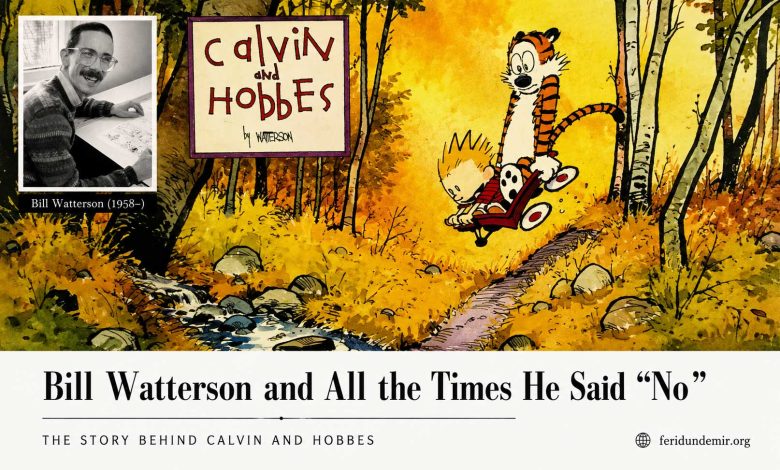
Bill Watterson’s greatest creation may not be Calvin and Hobbes.
Perhaps it was all the times he said “no.”
No, Hobbes will not become a toy.
No, Calvin will not go to television.
No, these characters will not appear on mugs, T-shirts, or keychains.
No, Calvin and Hobbes will not become a commercial empire.
And finally…
No, Calvin and Hobbes will not last forever.
Yet in 1995, Bill Watterson had no reason to say any of these things.
Calvin and Hobbes was being published all over the world. Since its debut in 1985, the strip had grown into a global phenomenon, appearing in more than 2,400 newspapers and finding its way into the lives of millions of readers. Children laughed at Calvin’s mischief, while adults discovered pieces of their own childhood in his endless questions.
Because Calvin and Hobbes was never just a comic strip.
It was about imagination.
It was about childhood.
It was about friendship.
And perhaps, in some way, it was about refusing to grow up.
The adventures of six-year-old Calvin and his best friend Hobbes became something larger than entertainment for many readers.
And maybe the reason was Hobbes himself.
Was Hobbes real?
For years, that was the question readers asked most often.
To Calvin, Hobbes was a living tiger. He talked, argued, played games, and went on adventures.
To adults, he was simply a stuffed toy.
Bill Watterson never gave a definitive answer.
In an interview, he explained:
“Calvin sees Hobbes one way, and everyone else sees Hobbes another way. Each version of reality makes complete sense to the person who sees it.”
Perhaps that was Hobbes’s magic.
And perhaps that is why Watterson never wanted Hobbes to become a toy.
The syndicate had big plans.
Toys.
T-shirts.
Animated series.
Even a stuffed Hobbes doll.
All of it promised millions of dollars.
But to Watterson, Calvin and Hobbes was not a product.
It was a comic strip.
One day he would say:
“Calvin and Hobbes was designed to be a comic strip and that’s all I want it to be. It’s the one place where everything works the way I intend it to.”
So he fought.
For years.
While many cartoonists turned their creations into television shows and merchandise, Watterson chose the opposite path.
He cared less about the fortune he could make than about the things he did not want to lose.
Maybe he was stubborn.
Maybe he disliked compromise.
Maybe he feared seeing his private world changed by others.
Whatever the reason, he refused to give in.
And eventually he got what he wanted.
No toys.
No movie.
No television series.
Just Calvin and Hobbes.
Then, in 1995, at only thirty-seven years old, he ended the strip.
He didn’t have to.
It was still enormously popular.
There could have been more books, more adventures, and far more money.
But Bill Watterson chose to stop.
On December 31, 1995, the final Calvin and Hobbes strip appeared in newspapers.
Calvin and Hobbes are walking through deep snow, pulling their sled behind them.
Calvin looks around and says:
“Wow.”
“It really snowed last night.”
In the final panel, he says:
“It’s a magical world, Hobbes, ol’ buddy…
Let’s go exploring.”
Most of the page is white.
An open world covered in snow.
Perhaps that is the most beautiful thing Bill Watterson left behind.
He created two of the most beloved characters in comic history.
He protected them.
And while everyone wanted more, he knew where to stop.
Sometimes the hardest word is not “yes.”
Sometimes the word that changes everything
is “no.”
Share this content:
Discover more from Feridun Demir
Subscribe to get the latest posts sent to your email.