Cartooning for Peace Defends Emad Hajjaj Amid Calls to Cancel His Appearance at LICAF

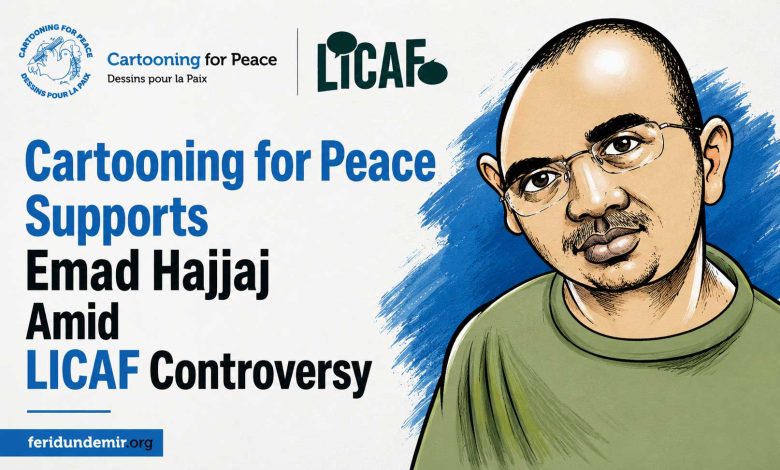
International press cartoon organisation Cartooning for Peace has expressed its full solidarity with Jordanian cartoonist Emad Hajjaj after British politicians called for his appearance at the 2026 edition of the Lakes International Comic Arts Festival (LICAF) to be cancelled.
The controversy emerged after the festival invited Hajjaj to participate in its October 2026 programme. Several British politicians and right-wing media outlets criticised the invitation over two of the cartoonist’s works criticising Israel, claiming the drawings were anti-Semitic.
Among those demanding action were British Prime Minister Keir Starmer and Conservative politician Chris Philp, who argued that public funding should not support the festival while hosting Hajjaj.
Responding to the accusations, Emad Hajjaj said:
“Any honest person who follows my work knows for certain that I have nothing to do with such an accusation.”
Speaking to the press, LICAF director Julie Tait explained that Hajjaj had been invited to launch “an anthology of comics and cartoons on mental and physical disabilities” and stressed that the festival had “never presented anti-Semitic cartoons or comics”.
This is not the first time the festival has faced criticism for inviting cartoonists critical of Israel.
Cartooning for Peace Statement
In a statement published on 13 May 2026, Cartooning for Peace strongly condemned what it described as a climate of growing polarisation and censorship targeting editorial cartoonists.
The organisation stated:
“Cartooning for Peace expresses its full solidarity with Emad Hajjaj and deplores a climate of extreme polarisation that encourages generalisations, exposing press cartoonists to censorship.
This lack of discernment, whether sincere or feigned, seriously undermines the quality of democratic debate and freedom of expression; it fosters a culture of self-censorship, to the benefit of extreme and simplistic views.”
The full statement can be read here:
Read the full Cartooning for Peace statement
Background of the Controversy
The backlash against Hajjaj intensified after British newspaper The Telegraph criticised LICAF for inviting the Jordanian cartoonist.
The criticism centres around two controversial cartoons.
One cartoon, originally drawn during the 2008 Gaza war, juxtaposed Nazi soldiers surrounding Jews with Israeli soldiers surrounding Palestinians.
Another cartoon, published after Donald Trump’s Gaza-related proposals in 2025, depicted Trump and Israeli Prime Minister Benjamin Netanyahu standing before an entrance resembling the gate of Auschwitz.
Supporters of Hajjaj argue that the cartoons represent political criticism of Israeli state policies rather than hatred against Jewish people. Critics, however, claim that Holocaust-related imagery crosses a line and fuels anti-Semitism.
Freedom of Expression and Political Cartooning
The case has become part of a wider international debate surrounding freedom of expression, political satire, and accusations of anti-Semitism in the context of the Gaza war.
Since October 2023, several artists, academics, journalists, and cultural institutions in Europe and North America have faced pressure campaigns, cancellations, or public criticism over pro-Palestinian positions or criticism of Israel.
For many in the cartooning world, the Emad Hajjaj controversy highlights growing concerns about censorship, self-censorship, and the shrinking space for political satire during periods of war and polarisation.
Share this content:
Discover more from Feridun Demir
Subscribe to get the latest posts sent to your email.