There are certain figures in the history of science who did more than make discoveries — they changed humanity’s understanding of the world itself. Louis Pasteur was one of them.
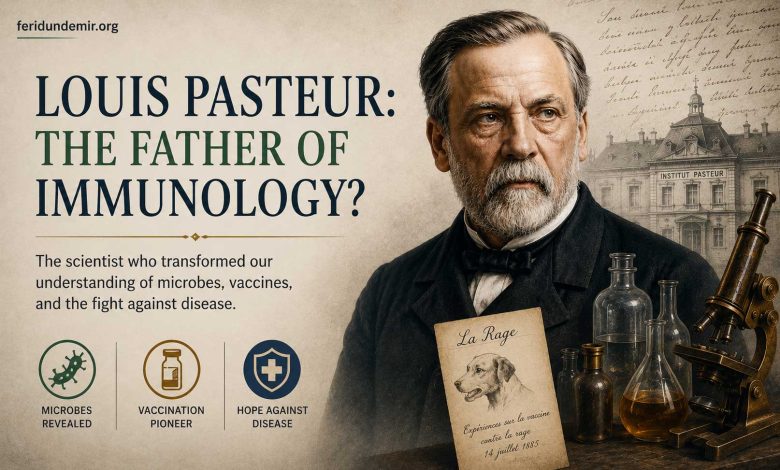
Today, Pasteur is remembered as one of the founders of microbiology, the pioneer of pasteurization, the scientist behind the first rabies vaccine, and one of the architects of modern vaccination. In many scientific and popular texts, he is even described as “the father of immunology.”
But is that title entirely accurate?
The answer is more complicated than it first appears.
Pasteur lived in a time when the modern concept of the immune system simply did not exist. Scientists had not yet discovered antibodies, immune cells, or even clearly distinguished between bacteria and viruses. The biological mechanisms of immunity were still hidden in darkness.
And yet, despite these limitations, Pasteur transformed humanity’s fight against infectious disease forever.
The Invisible World of Microbes
In the nineteenth century, many people still believed that decay, fermentation, and disease arose spontaneously from non-living matter. Rotting flesh, spoiled wine, or infected wounds were thought to be natural chemical processes rather than biological ones.
Pasteur challenged this worldview.
Through meticulous experiments, he demonstrated that microscopic organisms in the air were responsible for fermentation and putrefaction. Yeast, bacteria, and other microbes were not byproducts of decay — they were its cause.
This insight revolutionized science.
It reshaped industries such as wine, beer, dairy, and silk production, but more importantly, it laid the foundation for the germ theory of disease. If microorganisms could spoil food and liquids, perhaps they could also cause illness.
This was one of the most important turning points in medical history.
Beyond Jenner: The Expansion of Vaccination
Before Pasteur, Edward Jenner had already introduced vaccination against smallpox in 1798. Jenner’s work was revolutionary, but it remained largely empirical. It worked — even if no one truly understood why.
Pasteur took the idea much further.
He believed vaccination was not merely a unique solution for smallpox, but a universal principle that could potentially prevent many infectious diseases. Through his experiments on chicken cholera, anthrax, and rabies, he introduced the concept of weakened — or attenuated — microbes that could stimulate protection without causing severe disease.
This was a radical leap forward.
For the first time, infectious diseases appeared not simply as unavoidable disasters, but as biological processes that might be controlled and prevented.
The Great Irony: Pasteur Misunderstood Immunity
One of the most fascinating aspects of Pasteur’s legacy is that he fundamentally misunderstood how immunity actually works.
Pasteur believed that weakened microbes protected the body by consuming certain vital nutrients necessary for future microbial growth. In his view, once those nutrients were depleted, the invading pathogen could no longer survive inside the host.
Today, we know this explanation was incorrect.
Immunity is not caused by microbes exhausting nutrients. It results from the body’s active defense system — antibodies, immune cells, and immunological memory responding to foreign invaders.
Pasteur correctly observed the phenomenon of immunity, but misunderstood its mechanism.
And yet, history rarely remembers only those who were perfectly correct. Sometimes it remembers those who opened entirely new doors.
The Anthrax Vaccine and Scientific Rivalry
Pasteur’s anthrax vaccine became one of the great public triumphs of nineteenth-century science. But behind the triumph was a more complex and controversial story.
Another French scientist, Henri Toussaint, had already achieved protective immunity using heat-killed anthrax bacteria. This contradicted Pasteur’s belief that only live attenuated microbes could generate immunity.
Historical investigations later suggested that the famous Pouilly-le-Fort anthrax trial — the experiment that made Pasteur internationally famous — may actually have relied on a chemically treated vaccine closer to Toussaint’s approach than Pasteur publicly admitted.
This does not diminish Pasteur’s genius, but it reminds us that science is rarely a clean, heroic narrative. It is shaped by competition, ambition, secrecy, ego, and sometimes luck.
Pasteur was not only a scientist. He was also a master strategist in the emerging world of modern scientific prestige.
Rabies and the Birth of Hope
If anthrax made Pasteur famous, rabies made him legendary.
Rabies was among the most terrifying diseases of the nineteenth century. Once symptoms appeared, death was almost inevitable — and often horrific.
Pasteur realized that rabies had one unusual feature: a long incubation period. This created a small window of opportunity after infection but before symptoms emerged.
In 1885, a young boy named Joseph Meister was severely bitten by a rabid dog. Pasteur, despite not being a licensed physician, decided to attempt an experimental treatment using progressively more virulent preparations derived from infected rabbit spinal cords.
The boy survived.
The event electrified the world.
Pasteur instantly became an international scientific hero, and donations poured in from across the globe to support what would become the Institut Pasteur in Paris.
For many people, the rabies vaccine symbolized something larger than medicine itself: the idea that science could defeat fear.
So, Was Pasteur the Father of Immunology?
Strictly speaking, modern immunology was built later by scientists who uncovered antibodies, immune responses, cellular immunity, and immunological memory.
Pasteur did not discover those mechanisms.
But he accomplished something equally important.
He transformed immunity from an isolated medical curiosity into a scientific frontier.
He demonstrated that vaccination could become a universal strategy against infectious disease. He helped move medicine away from superstition and toward experimental biology. He turned microbiology into a practical force capable of changing everyday human life.
In that sense, calling Pasteur “the father of immunology” may not be technically perfect — but historically, it is understandable.
Because even when he was wrong about the mechanism, he was profoundly right about the future.
Conclusion
Louis Pasteur’s story reminds us that science does not advance in a straight line. Discovery is often built from partial truths, failed theories, rivalry, intuition, and fortunate accidents.
Pasteur did not fully understand immunity.
But he helped humanity imagine that infectious disease could be prevented before it struck. That idea alone changed civilization.
He revealed the invisible world of microbes. He transformed vaccination into one of humanity’s greatest medical tools. And he proved that scientific research could alter the destiny of millions.
That is why Louis Pasteur remains not only one of the giants of microbiology, but one of the defining scientific figures in human history.
Source
Kendall A. Smith, Louis Pasteur, the Father of Immunology?, Frontiers in Immunology, 2012.
Share this content:
Discover more from Feridun Demir
Subscribe to get the latest posts sent to your email.