The World Behind the Fences: From the Destruction of the Commons to the Rise of the Digital Proletariat

A digital artistic representation of a traditional wooden fence merging into a glowing technological circuit board, symbolizing the enclosure of data. From land to logic: The new boundaries of the 21st century.
The greatest ruptures in human history often occur in silence. There are no war cries, no declarations of victory. Yet their consequences echo for centuries. The dissolution of the commons is one such rupture.
This was not merely a transfer of land. It was a transformation of humanity’s relationship with nature. It was the loss of control over one’s own labor. And above all, it was the story of how free people became workers.
Once upon a time, what we call the “commons” could not be explained through modern notions of property. A pasture, a forest, or a field was not owned by an individual but belonged to a community. The peasant may not have owned the land, yet existed in a relationship of rights with it. Grazing animals freely on common pastures, collecting firewood from the forest, gathering leftover grain after harvest—these rights were not always written, but they were unquestioned within the moral fabric of society. Humans were not separated from nature; they were part of it. Livelihood was not competition, but a practice of sharing.
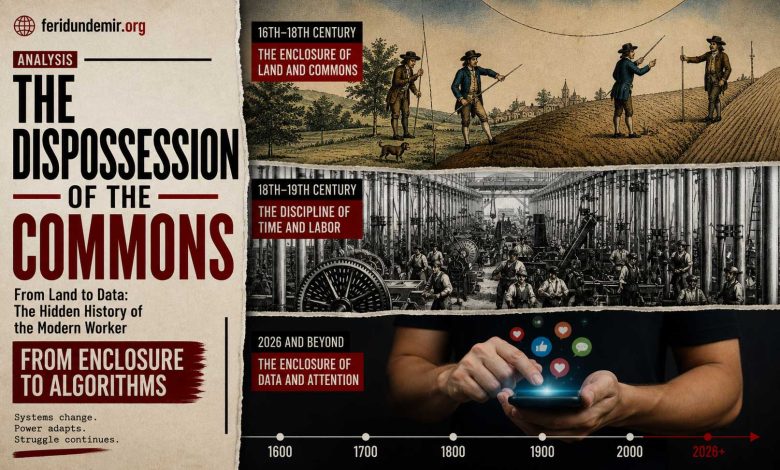
Beginning in the 16th century, particularly in England, the Enclosure movement shattered this order. Land was no longer a living space; it became an instrument of capital. Pastures were fenced, forests were restricted, fields were privatized. And one morning, people realized they no longer had a place to live.
Peasants who lost access to pasture could no longer sustain livestock, and dependency replaced autonomy. Displaced populations were criminalized through vagrancy laws and forced into labor. What was once a communal right—gathering leftover crops—became theft, and people were punished for collecting even a single grain. Forests, once sacred commons, were enclosed by states and aristocracies; collecting firewood became illegal, and survival itself was commodified. This very process pushed Karl Marx toward political economy.
When pastures, forests, and fields were enclosed, a vast population remained with nothing: the working class. This transformation was not a choice, but a necessity. Nature’s rhythm gave way to machine rhythm; sunrise was replaced by the clock-in, and life itself became shift work. Time was enclosed just as land had been. The worker no longer owned what they produced, did not control the process, and could not determine the value of their labor. Just as the right to glean was taken, so too was the right to one’s own production.
Today, physical commons have long been enclosed, yet the story did not end. Everything we upload to the internet has become a kind of digital grain: text, images, behavior, attention. But the question remains—who harvests these grains?
OpenAI, led by Sam Altman, with ChatGPT; Google, led by Sundar Pichai, with Gemini; Microsoft, led by Satya Nadella, with Copilot; Meta, led by Mark Zuckerberg, with its AI systems; Amazon, led by Andy Jassy, with Bedrock and Alexa AI; xAI, led by Elon Musk, with Grok; and Anthropic, led by Dario Amodei, with Claude. These entities no longer merely build technology; they harvest data, analyze behavior, and shape the future. Once, land was enclosed; now, knowledge is enclosed.
The fences of today are invisible—algorithms, data policies, AI models. We are no longer losing land, but our attention and cognition. In this new system, everyone produces content, generates data, and feeds algorithms. And in return, there is no ownership, no share, no control.
Dispossession Through Time
| Era | Enclosed Resource | Transformed Class | Mechanism of Control |
|---|---|---|---|
| 18th Century | Land & Pastures | Factory Worker | Law & Violence |
| 19th Century | Time & Craft | Assembly Worker | Discipline & Clock |
| 2026 | Data & Attention | Digital Proletariat | Algorithms |
The working class is not just an economic category; it is a condition of loss. The land is gone, the forest is gone, and now the question is whether the mind is next.
The end of the commons marked the end of human self-sufficiency. Yet history teaches us that no fence lasts forever. Perhaps the real struggle today is not for wages, nor even for land or data, but for reclaiming human autonomy itself.
Share this content:
Discover more from Feridun Demir
Subscribe to get the latest posts sent to your email.